
Tennis Betting in Ontario

Tennis betting in Ontario is not what the calendar suggests. The four Grand Slams take up eight weeks of the year, but the sport runs somewhere on earth almost every day, and that is why tennis turns up on an Ontario live board more reliably than hockey does.
We counted. On one Ontario board at 10:25 in the morning, tennis led every other sport with more than 50 events in play — ahead of soccer on about 40, with basketball, hockey and baseball all in single figures. Four hours earlier, on a different board, tennis was one of only four sports live at all.
That availability has a cost attached, and it is the part no tennis betting guide mentions: the matches keeping those boards busy overnight are the smallest professional events in the sport, and they are where every integrity alert in the game is concentrated.
Tennis Betting in Ontario: What We Found
- Tennis led an Ontario live board with 50+ events at 10:25 a.m., more than any other sport on that screen — roughly double the next sport down.
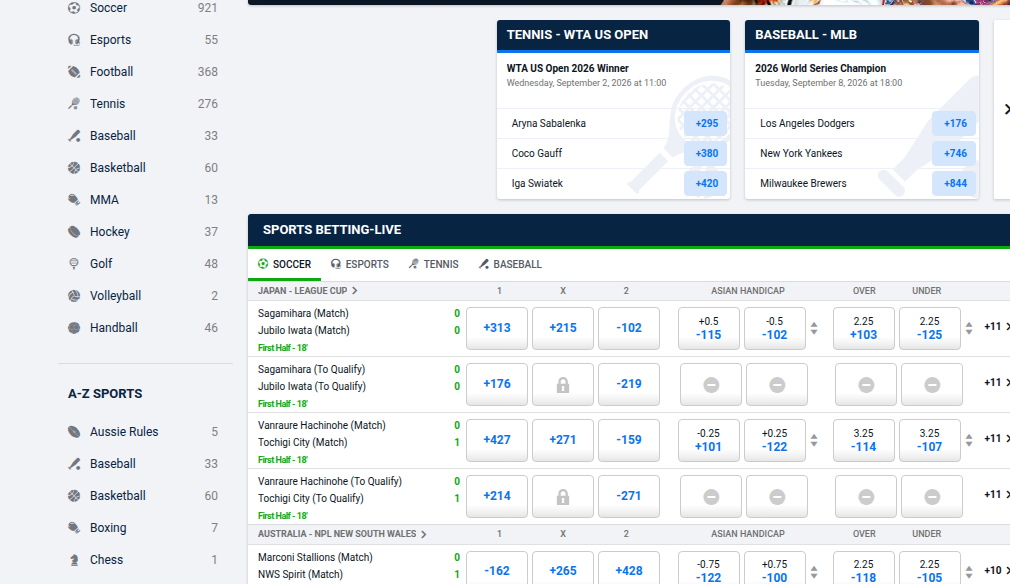
- One Ontario board listed 250+ tennis events across its whole card the same morning, third behind soccer and football.
- Tennis is the sport you are most likely to be allowed to watch. Where an Ontario book streams anything at all, ATP and WTA tennis is usually on the list – the NHL, NBA, MLB and NFL are not.
- Junior tennis is off limits. The Registrar’s Standards require the majority of participants to be 18 or older, which rules out the junior draws at the Grand Slams.
- All 10 integrity alerts the ITIA received in Q2 2026 came from the lower tiers. None came from the ATP Tour, the WTA Tour or a Grand Slam.
Last verified: 18 September 2026. Live-board counts are snapshots taken at a specific time and change through the day.
These are Ontario-registered sportsbooks that appear on this page. This is not a tennis ranking – for a province-wide comparison see our ranking of Ontario sportsbooks, or the full list of registered operators.












Tennis Betting in Ontario
Every sportsbook registered with the AGCO prices tennis, and most of them price it every day of the year. The sport is priced in two distinct ways, and knowing which one you are looking at matters more in tennis than in any other sport.
Match betting is a single fixture: who wins, in how many sets, over how many games. Tournament betting is the draw as a whole: who lifts the trophy, who reaches the final, who comes out of the top half. A Grand Slam runs for a fortnight, so the tournament market stays open far longer than a match market ever does, and it reprices after every round.
What separates one Ontario board from another is not whether tennis is there. It is how far down the tours the board goes, how many markets it prices on a single match, and whether it lets you bet while the match is being played. Tennis is a two-player sport in singles, which removes the draw from the equation entirely – there is no 1X2 market in tennis, because somebody has to win.
For how the province’s boards compare across every sport, see our guide to sports betting in Ontario, and for how the market is regulated, our page on legal sports betting in Ontario.
How We Checked Ontario’s Tennis Boards
Everything on this page that is a count came from a screen we opened ourselves, over a Canadian connection, at a stated time.
Tennis Leads the Live Board More Often Than You Think
The received wisdom is that tennis is a niche next to hockey in this province. On a live board, at most hours of the day, the opposite is true.
At 10:25 a.m. Eastern on 2 September 2026, an Ontario live bar read tennis 56, soccer 41, basketball 9, hockey 5, baseball 1. Tennis was not competitive with the other sports; it was double the next one. Four hours earlier, at six in the morning, a different Ontario board had only four sports in play at all – and tennis was one of them, alongside soccer, esports and baseball.
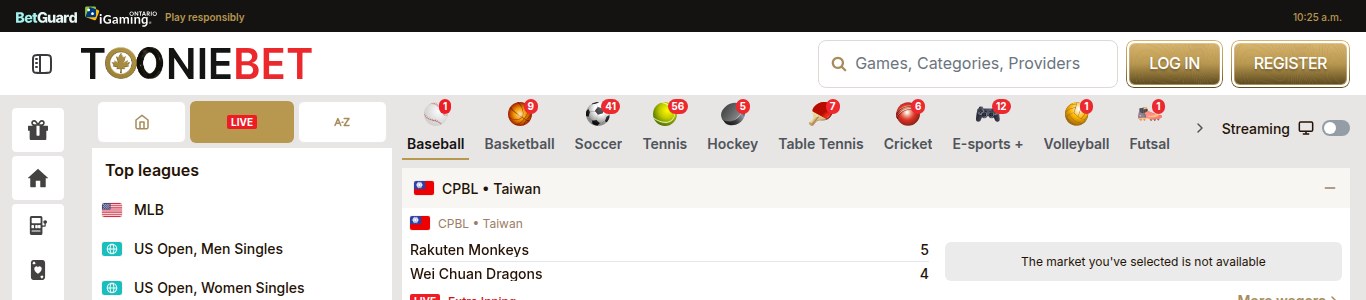
The reason is structural. Hockey and basketball are regional sports with a season and a time zone. Tennis is played on every continent in overlapping weeks, from Australian hard courts in January to indoor European events in November, with the entry-level tours running almost without interruption. When North America is asleep, tennis is what an Ontario board has to sell.
The same pattern shows up in the pre-match card. On the same morning, one Ontario board listed 250+ tennis events across its whole board — behind soccer, which ran into four figures, and football on 350+, but ahead of everything else. Two days earlier the same board had listed slightly fewer.
That is the season laid out in advance, not what is live. The two numbers measure different things, and they are covered in full on our live betting page.
The Tennis You Cannot Bet On in Ontario
Ontario does not let a registered sportsbook price every tennis match that exists, and the rule that stops it is the same one that keeps major junior hockey off the boards.
The Registrar’s Standards for Internet Gaming set out what makes an event eligible. Requirement 4 of Standard 4.34 is the one that matters for tennis: a permitted event requires that “the majority of participants in the event or league are 18 years of age or older”.
Junior tennis fails that test. The junior draws that run inside the Grand Slams during the second week are not available on an Ontario account, and neither is the ITF junior circuit, however prominently the tournament is branded.
Requirement 5 adds a second condition, and it is the one that shapes tennis specifically. An event must be “effectively supervised by a sport governing body which must, at minimum, prescribe final rules and enforces codes of conduct that include prohibitions on betting by insiders”.
In tennis that supervision runs through the tours and the International Tennis Integrity Agency — which is why the lower reaches of the professional game, not the junior game, are where the interesting questions sit.
What this means in practice
A Grand Slam fortnight has senior singles, senior doubles, wheelchair events, legends events and junior draws running on the same grounds under the same tournament name. Your Ontario account will price the senior professional events and will not price the junior ones. If you cannot find a match on the board during the second week of a Slam, check which draw it belongs to before you assume the board is thin.
How to Bet on Tennis in Ontario
The mechanics are the same as any other sport, with one simplification and one complication.
Singles is a two-player market. That is the simplification: no draw, no 1X2, two possible outcomes. Doubles works the same way with four players in two pairs.
Tennis Betting Markets
Tennis has a nested scoring system – points build games, games build sets, sets build the match – and the betting markets follow that structure exactly. This is what makes tennis unusually rich to bet and unusually easy to misread.
Match Winner
The moneyline: which player wins. There is no draw, so the two prices cover every outcome between them. Add the implied probabilities together and the excess over 100% is the book’s margin. Retirements are handled by the book’s own rules, and those rules differ – some settle once one ball is struck, some void the bet entirely.
Set Betting
The winner of a specific set, or the exact number of sets. First set winner is a separate market from the match, and priced separately, because a player can lose the first set and still win comfortably. Number of sets played is normally an over/under at 2.5 in a best-of-three match, or 3.5 and 4.5 in the best-of-five men’s Grand Slam format.
Game Handicap
A spread applied to games rather than sets. A line of -4.5 games means your player has to finish at least five games clear across the whole match. A 6-3, 6-4 win is 12 games to 7, a margin of five, which covers. A 7-6, 6-4 win is 13 games to 10, a margin of three, which does not.
Total Games
Over or under the total number of games in the match, or in a single set. A set total is commonly set around 9.5: a set cannot contain fewer than six games, and cannot contain more than 13, which is why the range is so much tighter than a totals line in other sports. Surface matters here more than form does.
Player Props
Individual statistical markets: total aces, total double faults, games won by a named player, sets won, break points converted. Ace lines move with the surface and the server – two big servers on grass can carry a combined line above 20, while the same pair on clay is priced far lower.
Set and Game Props
Markets tied to specific moments rather than totals: whether the match contains a tiebreak, whether a player wins a set to nil, whether the match goes to a deciding set. These are the markets that exist because tennis is scored in blocks.
Correct Score
The exact result in sets – 2-0 or 2-1 in a best-of-three, 3-0, 3-1 or 3-2 in a best-of-five. Six outcomes in a men’s Slam match, four in everything else. Longer odds than the moneyline because you are pricing the shape of the match and not only the winner.
Tournament Futures
Outright markets on the draw: tournament winner, finalist, semi-finalist, or the winner of a named quarter or half. These reprice after every round, and unlike a match market they can be open for two weeks.
Parlays
Several selections combined into one bet, where every leg must win. Tennis parlays are usually built from short-priced favourites across a day’s play, which is what makes them attractive and what makes them fragile – a single retirement takes the whole ticket. Some books allow same-match combinations of sets, games and props.
| Market | Typical line | What decides it |
| Match winner | Two-way price | Who wins the match; no draw exists |
| Set handicap | -1.5 / +1.5 | -1.5 needs a straight-sets win |
| Number of sets | Over/under 2.5 | Whether the match goes the distance |
| Game handicap | Around -4.5 | The margin in games across the match |
| Total games in a set | Around 9.5 | Minimum six games, maximum 13 |
| Total aces | Varies by surface | Server quality and court speed |
| Correct score | 2-0, 2-1, 3-2… | The exact set result |
| Tournament winner | Outright | The whole draw, repriced each round |
For how these market types work across other sports, see our guide to betting markets.
ATP Tennis Betting
The ATP Tour is the men’s professional circuit, and it is the tier an Ontario board prices most heavily. It is organised in bands: the four Grand Slams sit outside the tour itself, then the Masters 1000 events, then ATP 500 and ATP 250 tournaments, and the season closes with the ATP Finals between the year’s leading eight players.
Canada has one of the Masters 1000 events – the National Bank Open, played in Toronto and Montreal in alternating roles with the women’s tournament. It is the one week of the year when the men’s tour is on Ontario soil, and it is priced like any other Masters event on a provincial board.
Below the tour sit the ATP Challenger Tour and the ITF World Tennis Tour. These are professional events, they are legal to bet in Ontario, and they are a large share of what fills a live board outside North American hours. They are also where the integrity picture changes, which is covered further down this page.
Men’s matches are best-of-three sets everywhere except the Grand Slams, where they are best-of-five. That single difference changes the totals, the set markets and the correct-score market completely, so a line that looks generous may simply be a five-set line.
WTA Tennis Betting
The WTA Tour is the women’s professional circuit, structured in a similar way: the Grand Slams, then WTA 1000, WTA 500 and WTA 250 events, closing with the WTA Finals. The National Bank Open week hosts the women’s 1000 event in whichever of Toronto or Montreal the men are not playing that year.
Women’s matches are best-of-three sets at every level, including the Grand Slams. That makes the market structure more consistent than on the men’s side – a correct-score market is always 2-0 or 2-1, and a number-of-sets line is always set at 2.5.
Ontario boards price the WTA alongside the ATP, and where an operator streams tennis at all, both tours are usually included in the same arrangement. Market depth on a WTA 250 is generally thinner than on a Masters event, in the same way it is on the men’s side: the further down the tier, the fewer props survive.
Grand Slam Betting
The four Grand Slams are the deepest tennis markets of the year on any Ontario board. They are the events where player props appear on matches that would carry a moneyline and nothing else in an ordinary tour week, and where outright markets stay open for a fortnight.
| Tournament | Surface | What it does to the markets |
 Australian Open Australian Open |
Hard | Opens the season in January, when form from the previous year is the only guide available |
 French Open French Open |
Clay | Long rallies push game totals up and ace lines down; the surface favours attrition over serve |
 Wimbledon Wimbledon |
Grass | The fastest surface: ace props and tiebreak markets carry their highest lines of the year |
 US Open US Open |
Hard | Closes the Slam calendar in late summer with the deepest live coverage of the four |
Australian Open
Played on hard courts in January. Because it opens the season, the outright market is priced on limited recent evidence and moves sharply once the first rounds are played. Heat policy and scheduling can affect in-play markets more than at the other three.
French Open
Played on clay from late May into June. Clay slows the ball, rallies lengthen, and service advantage shrinks – so game totals sit higher and ace lines sit lower than on any other surface. Straight-sets prices are generally longer here.
Wimbledon
Played on grass in the second half of the summer. The surface is the fastest of the four and rewards serving above everything, which pushes ace props and tiebreak markets to their highest lines of the year and makes upsets in early rounds more common.
US Open
Played on hard courts from late August into September. It usually carries the deepest live coverage of the four on an Ontario board, and it is the Slam most likely to be streamed where an operator offers tennis video at all.
Remember that the junior draws running alongside these tournaments are not available on an Ontario account, whatever the tournament branding says.
The National Bank Open: Ontario’s Own Tour Stop
Every other tennis guide written for this province treats the season as four Slams and a lot of filler. That skips the one week the tour is actually in Ontario, and it is the week an Ontario board prices most heavily.
The National Bank Open presented by Rogers is Canada’s combined ATP 1000 and WTA 1000 event. It was the Rogers Cup until 2019 and the Canada Masters before that, which is why older guides and some operator calendars still carry the old names.
Which Tour Is in Toronto This Year
Since 2021 the rotation has been fixed, and it is the single most useful thing to know before the entry lists come out:
| Year | Toronto – Sobeys Stadium | Montreal – IGA Stadium |
|---|---|---|
| Odd-numbered | Men’s ATP 1000 | Women’s WTA 1000 |
| Even-numbered | Women’s WTA 1000 | Men’s ATP 1000 |
The Canadian Angle, and Why It Moves Prices
Home players draw money, and an Ontario board knows it. That is not a reason to bet them, but it is a reason to look at the price twice: a market where local support is one-sided is a market where the value, if there is any, sits on the other side.
There is also a long drought worth knowing about. Victoria Mboko won the women’s title in 2025. On the men’s side the last Canadian champion was Robert Bedard, in 1958 – a gap of nearly seventy years that outright markets have priced correctly for most of that time.
The Ontario Players Worth Knowing
Every guide that lists “players to watch” picks the same six names off the world rankings. That is a list you can get anywhere. What an Ontario bettor actually needs is narrower: the players whose matches move the money on a provincial board, and three of them grew up here.
| Player | Ontario connection | Career high | What they have already done |
|---|---|---|---|
| Bianca Andreescu | Born in Mississauga | No. 4 | Won the 2019 US Open, beating Serena Williams 6-3, 7-5, and took the home title in Toronto the same year – the first Canadian to win it since Faye Urban in 1969 |
| Denis Shapovalov | Grew up in Vaughan | No. 10 | Wimbledon semi-finalist in 2021, and part of the team that won Canada’s first Davis Cup in 2022 alongside Felix Auger-Aliassime and Vasek Pospisil |
| Victoria Mboko | In Toronto since she was two months old | No. 9 | Won the 2025 National Bank Open at 18, beating Naomi Osaka 2-6, 6-4, 6-1 – the third Canadian to win the home tournament |
Andreescu’s 2019 is the reference point for what a home run does to a market. She arrived as an outsider, beat the most recognisable player in the sport twice inside two months, and ended the year as the highest-ranked Canadian woman in WTA history. Outright prices that started the fortnight long finished it very short.
Mboko is the current version of the same story, and the more useful one to watch, because she is 19 and the ranking is still moving – she reached No. 9 in March 2026.
Two more names carry the same effect without the Ontario address: Felix Auger-Aliassime and Leylah Fernandez, both from Quebec. They appear on every Canadian board during the Slams and the National Bank Open, and they draw the same weight of local money.
Where Tennis Integrity Alerts Come From
This is the part of tennis betting that no operator page will tell you, and it is worth more than any tip.
The International Tennis Integrity Agency publishes what it receives. In its quarterly update for Q2 2026, the ITIA reported 10 match alerts – reports of betting patterns that warrant investigation, received through confidential agreements with the regulated betting industry. An alert is not proof of anything, and the ITIA is explicit about that. What matters is where they came from.
| Tour level | Alerts, Q2 2026 |
| Men’s ITF World Tennis Tour 15s | 5 |
| ATP Challenger 75 | 2 |
| Men’s ITF World Tennis Tour 25s | 2 |
| Women’s ITF World Tennis Tour 15s | 1 |
| ATP Tour | 0 |
| WTA Tour | 0 |
| Grand Slams | 0 |
Every single alert came from the entry-level and second-tier professional circuits. None came from the ATP Tour, the WTA Tour or a Grand Slam.
Now put that beside the live-board counts at the top of this page. The matches that keep an Ontario tennis board busy at six in the morning are drawn from exactly those lower tiers, because that is what is being played while North America sleeps. The sport’s availability and the sport’s integrity risk are concentrated in the same place.
This is not an argument against betting tennis. It is an argument for knowing which tier you are betting, which is a thing the board will tell you if you read the tournament name above the match.
Tennis Betting Sites in Ontario
Every operator on the iGaming Ontario register prices tennis, so the question is never whether tennis is available. It is how deep the board goes and what the operator lets you do with it.
Judged on what we counted and what operators publish, the differences that actually show up are these: how far down the ATP Challenger and ITF tiers a board is willing to price, how many markets survive on a minor match, whether the in-play board carries tennis at unsocial hours, and whether tennis video exists.
On that last point tennis is the exception in this market. Where an Ontario operator streams anything at all, tennis is usually in the list.
One Ontario help centre states plainly that its streams cover ATP and WTA tennis, European soccer and table tennis — and tells you to find the official broadcaster yourself for the NHL, NBA, MLB, NFL and Premier League. Another lists table tennis, tennis, European basketball and soccer as its streamed sports.
The reason is commercial rather than technical: tennis streaming rights at tour level are obtainable in a way North American league rights are not.
We do not publish a tennis-specific ranking. For a comparison across the whole province, see our ranking of Ontario sportsbooks; for who is registered and what each one ships, the full list.
Live Tennis Betting
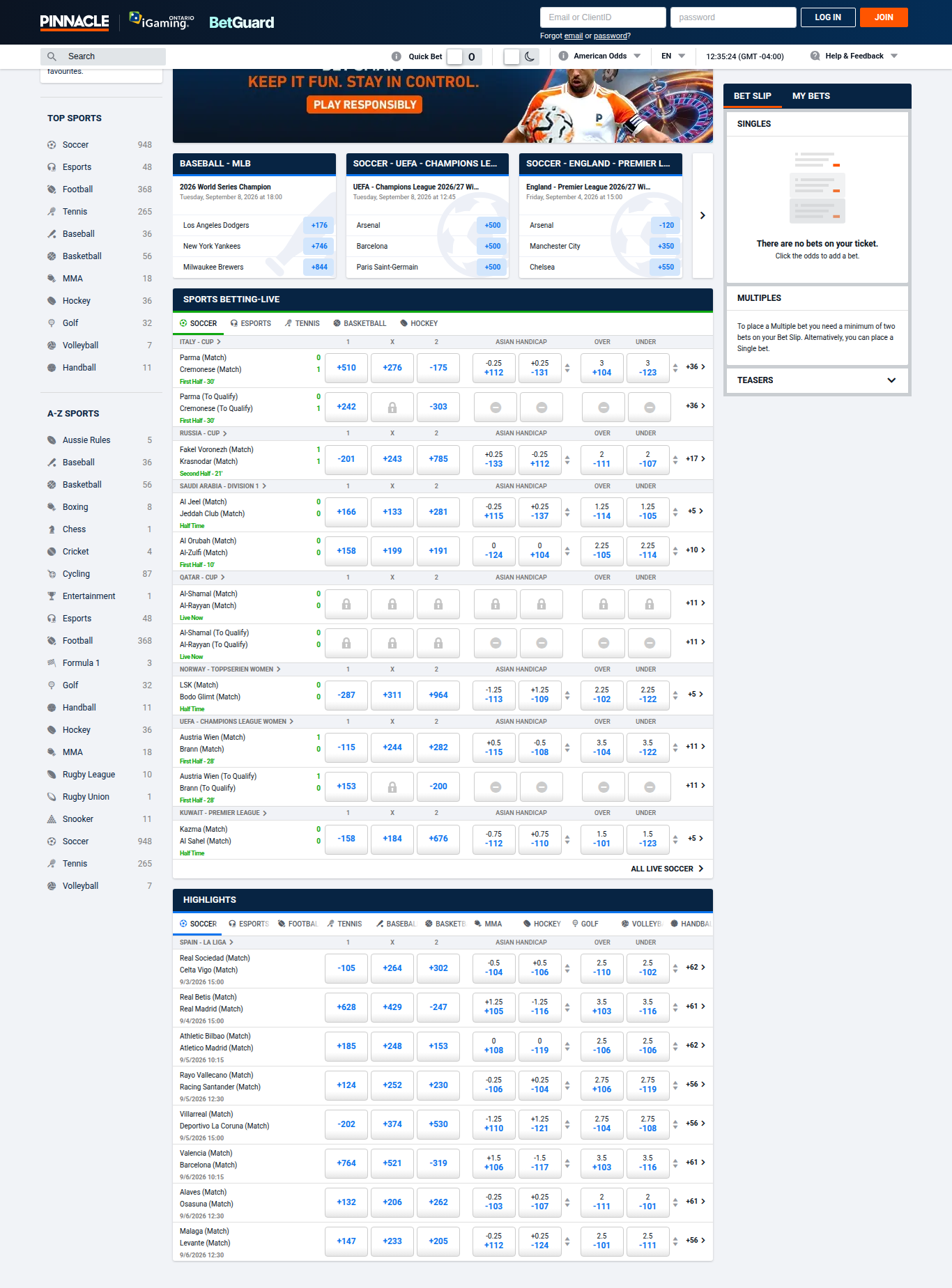
Tennis has the most natural in-play structure of any sport. There is a new market at every game and every set, a natural pause between points, and a scoring system that produces a genuine swing in win probability at a single break of serve.
That is also what makes it dangerous to bet quickly. A break of serve moves a live match price further than a goal moves a soccer price, and the market is suspended while the book reprices. The odds you are looking at between points are the odds for a situation that has already changed.
Three things behave differently in tennis in play:
How the in-play delay works, what cash out does during a live bet, and which Ontario boards carry what, is covered on our live betting guide.
Tennis Betting Apps
Most tennis bets in this province are placed on a phone, and tennis exposes an app in a particular way: the sport is played through the working day in North America, and the markets renew every few minutes.
What matters on a tennis app is how fast the bet slip reacts when a price changes mid-game, whether the live tennis board is reachable in one tap, and whether streaming – where the operator has it – runs inside the app rather than sending you elsewhere. Tennis is one of the few sports where in-app video genuinely exists on an Ontario account.
Every registered Ontario operator we have reviewed ships an iOS app and almost all of them ship on Android. For ratings, update dates and what each app actually carries, see our page on Ontario betting apps.
Tennis Betting Odds
Tennis odds are read the same way as any other sport, with one quirk worth understanding. Each price carries an implied probability – a money line of -250 implies 71.4%, +200 implies 33.3% – and the two sides of a two-way market always add to more than 100%. That excess is the operator’s margin.
Because there is no draw, tennis prices run to extremes that other sports do not produce. A top seed against a qualifier can be priced beyond -2000, where the implied probability sits above 95% and the return on a winning bet is a few cents on the dollar. Those prices are not errors; they reflect a sport where the better player wins far more often than in team competition.
In play, the arithmetic is the same but the movement is not. A single break of serve can move a match price from -150 to -400 in one game, and the market will be suspended while that repricing happens. What you are offered after the resumption is a new price, not the one you were looking at.
We have not measured tennis pricing across Ontario operators, so this page makes no claim about which board prices tennis best. What we can say is that depth and price are separate questions: the board with the most tennis events is not automatically the one pricing them keenest.
How to Choose a Tennis Betting Site
For the comparison methodology across the province, see our ranking of Ontario sportsbooks.
Legal Tennis Betting in Ontario
Tennis betting is part of the regulated market that opened on 4 April 2022. There is no separate permission for tennis: any operator registered with the AGCO and operating through iGaming Ontario may price it, subject to the eligibility rules in Standard 4.34 described above.
Two conditions apply to every bet. You must be 19 or over, and you must be physically inside Ontario when the bet is placed. Registered operators verify both, and a bet placed from outside the province will be refused.
Before depositing anywhere, confirm the operator is on the register rather than taking a badge at face value. Our page on legal sports betting in Ontario explains how to check and what the register does and does not cover.
Betting on Tennis Responsibly
Tennis runs almost continuously, which is precisely the risk. A sport with matches available at every hour of the day removes the natural stopping point that a fixture list gives you in hockey or football, and the in-play markets renew every few minutes.
You must be 19 or over and physically in Ontario to bet with a registered operator. Sportsbooks registered with the AGCO are required to offer deposit limits, time limits and self-exclusion. On a sport that is always on, a time limit does more work than a deposit limit.
If betting has stopped being entertainment, ConnexOntario is free, confidential and available around the clock on 1-866-531-2600.
Frequently Asked Questions
- Is tennis betting legal in Ontario?
Yes. Tennis is part of the regulated market that opened on 4 April 2022, and any operator registered with the AGCO may price it. You must be 19 or over and physically in Ontario when you place the bet.
- Can I bet on ATP and WTA matches in Ontario?
Yes, both tours are priced by every registered Ontario sportsbook, from the Grand Slams down through the Masters 1000, 500 and 250 events. Coverage below tour level, on the Challenger and ITF circuits, varies by operator.
- Can I bet on junior tennis at the Grand Slams?
No. The Registrar’s Standards require the majority of participants in an event to be 18 or older, which excludes the junior draws that run inside the Grand Slams. Only the senior professional events are available on an Ontario account.
- What is set betting in tennis?
Set betting covers the winner of a specific set or the exact set result of the match. A set handicap of -1.5 needs your player to win in straight sets, while +1.5 still pays if they lose one set and win the match.
- What is a tennis game handicap?
It is a spread applied to games rather than sets. At -4.5 games your player must finish at least five games clear across the whole match: a 6-3, 6-4 win is a five-game margin and covers, while 7-6, 6-4 is only three and does not.
- What does total games mean in tennis betting?
It is an over/under on how many games are played, either in the match or in a single set. A set line sits around 9.5, because a set cannot contain fewer than six games or more than 13.
- Can I bet on tennis live in Ontario?
Yes, and tennis suits it better than most sports because a new market opens at every game and set. Prices move in steps rather than drifting, jumping when serve is broken, and the market is suspended while the book reprices.
- Which sport leads Ontario live boards most often?
More often than people expect, it is tennis. On 2 September 2026 at 10:25 a.m. one Ontario live bar showed tennis on 56 events, ahead of soccer on 41, basketball on 9 and hockey on 5.