
Betting Markets in Ontario
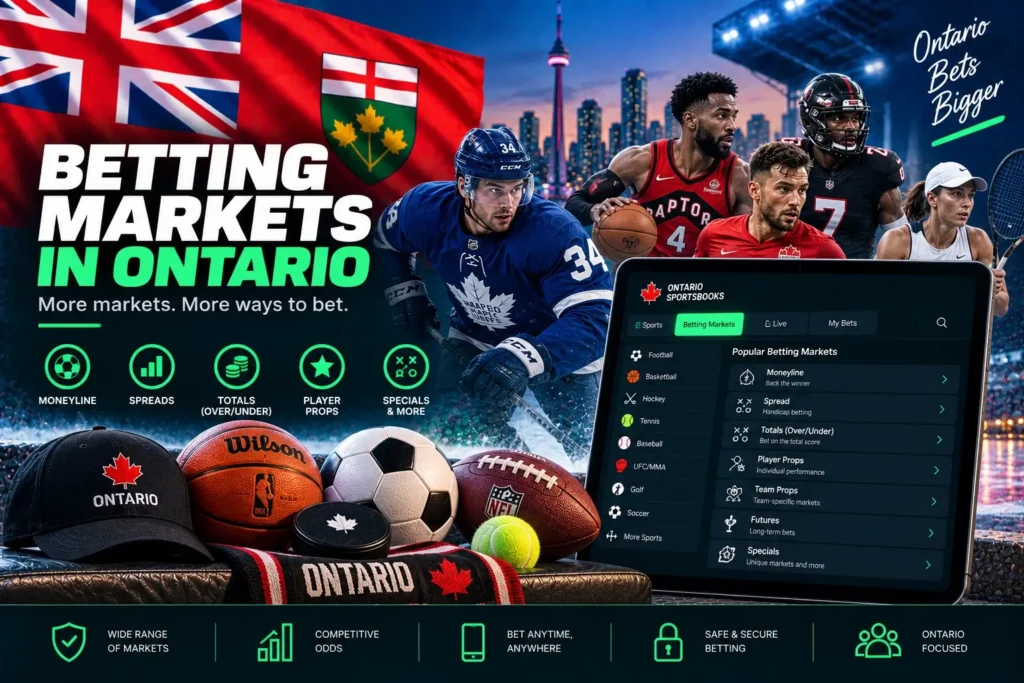
A betting market is the specific question you are betting on, not the game itself. One Ontario hockey game can carry a moneyline, a puck line, a total, period markets and hundreds of player props — and how many of them exist depends on the sportsbook, not the sport.







Betting Markets in Ontario
Every bet you place is a bet on one market. The match is the event; the market is the question — who wins, by how much, how many goals, or what one player does. Ontario sportsbooks build hundreds of these around a single fixture.
Main Sports Betting Markets
Seven markets account for the overwhelming majority of bets placed in Ontario. Everything else on a sportsbook is a variation on one of them.
| Market | What you are betting on | Typical use |
| Moneyline | Which side wins, outright | The simplest bet in any sport with a winner |
| Point spread | Which side wins after a handicap is applied | Evening out a mismatch between two teams |
| Totals | Whether combined scoring goes over or under a line | Betting the shape of a game without picking a side |
| Player props | What one named player does | Following a player rather than a result |
| Team props | What one team does, regardless of the result | A view on one side only |
| Futures | An outcome settled weeks or months away | Season-long positions |
| Parlays | Several selections that must all land | Combining views for a longer price |
Ontario books show decimal or American odds, switchable in settings. American is the default on most North American boards, and it reads like this:
| Market | What the screen shows | What it means |
| Moneyline | Home -180 | Risk $180 to win $100. The minus sign marks the favourite |
| Moneyline | Away +150 | Risk $100 to win $150. The plus sign marks the underdog |
| Puck line | Home -1.5 (+140) | The home side must win by two or more; $100 returns $240 |
| Total | Over 6.5 (-110) | Seven goals or more wins; risk $110 to win $100 |
| Player prop | Player over 0.5 goals (+120) | That player must score at least once |
| Future | Team +900 to win the cup | $100 returns $1,000, settled at the end of the season |
Moneyline
The moneyline asks one question: who wins? No handicap, no margin. The favourite pays less than your stake in profit and the underdog pays more, which is how the sportsbook expresses who it thinks will win.
In soccer and other draw sports the same market is three-way — home, draw, away — which is why a moneyline mindset misleads there. Our soccer betting page covers that difference in detail.
Point Spread
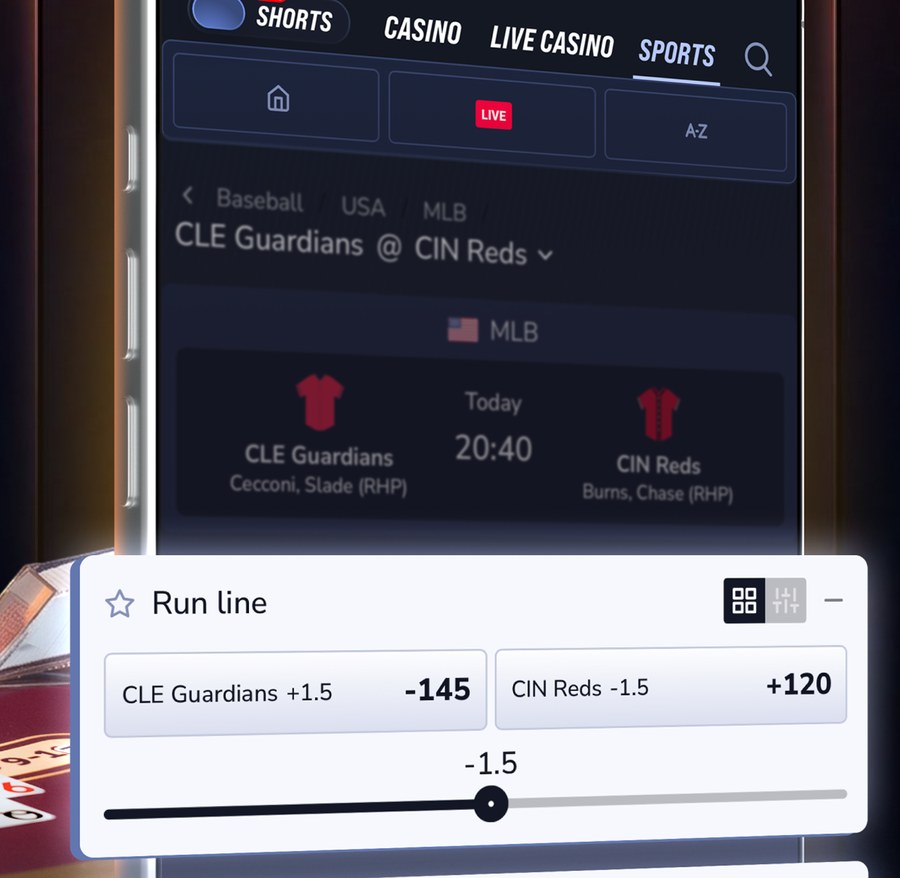
The spread applies a handicap to the favourite so that both sides sit at a similar price. A team at -6.5 must win by seven or more; the other side covers if it loses by six or fewer, or wins outright.
The half-point exists to remove ties. In hockey and baseball, where scores are low, the same idea appears as the puck line and the run line, almost always set at 1.5.
Totals (Over/Under)
The sportsbook sets a number for combined scoring and you bet whether the real figure lands above or below it. A 2.5-goal total in soccer means two goals is under and three is over, with no possibility of a push.
Totals are the market most often available on alternative lines — the same game priced at several different numbers, each with its own odds.
Player Props
Props on a named player: goals, points, assists, shots, rebounds, touchdowns, strikeouts. This is the market that has grown fastest, and the one that varies most between sportsbooks — a marquee game may carry dozens while a midweek fixture carries none.
Player props are also the first markets to disappear once a game starts, which matters if you plan to bet in play.
Team Props
The same idea applied to one side rather than one player: team totals, whether a team scores first, whether it scores in both halves. Useful when you have a view on one team and no view on the result.
Futures
Markets settled at the end of a season or tournament — the Stanley Cup, the NBA championship, the Super Bowl, an MLS title, a league’s top scorer. Your stake is committed for as long as the market runs, which is the trade-off for the longer price.
Parlays
A parlay combines several selections into one bet, and every selection must land. The odds multiply, and so does the risk: one leg failing settles the whole slip as a loss.
Same-game parlays apply the same idea inside a single fixture. The difference matters: the legs are priced together rather than multiplied, because they are related. Two legs that both depend on a high-scoring game are not independent events, and the sportsbook prices them accordingly.
Alternative Lines
Most main markets are also offered at numbers other than the default. A 6.5-goal total in hockey will usually sit alongside 5.5 and 7.5, each at its own price, and a spread will be offered either side of the headline number.
Alternative lines are the quietest way a board gets deep: one market becomes six or eight, and the market count climbs without a single new type of bet being added.
How Many Markets a Single Game Actually Has
“Thousands of markets” is the most common claim in this industry and the least verifiable. So we counted what individual games actually carried on Ontario boards.
Two things follow from that. The first is that a four-fold gap separates the deepest Ontario board from the thinnest on the same kind of fixture, so “how many markets” is a real question with a real answer, not marketing.
What Happens When the Game Starts
The second is the orange row, and it is the more useful one. The board that carried roughly 400 markets before the first pitch was showing 15 to 18 once the game was under way — not because the sportsbook withdrew them, but because most props had already settled or suspended.
Anyone planning to bet in play is looking at a different product from the one advertised. The pre-match count tells you almost nothing about what will be on the screen at kick-off.
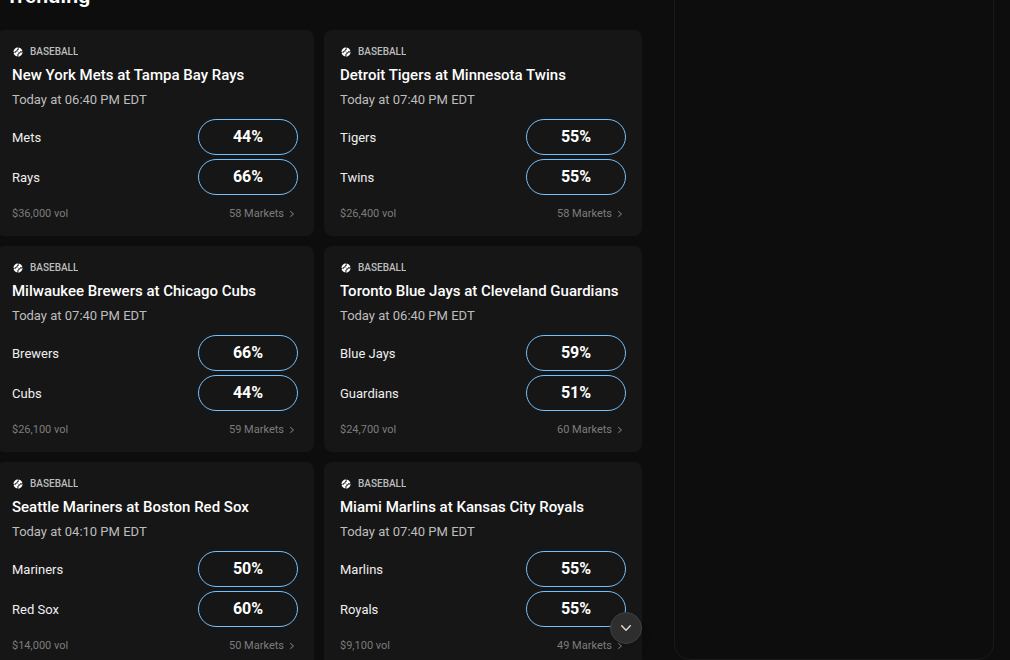
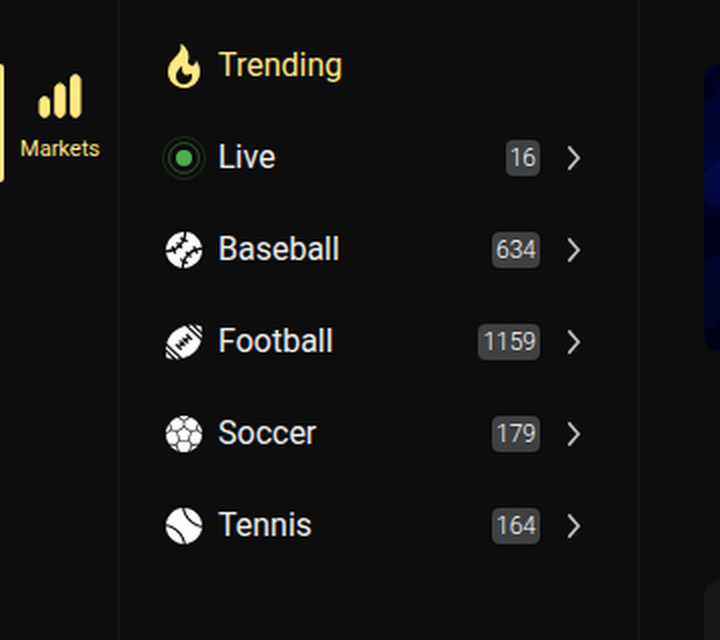
Almost no Ontario sportsbook publishes a market count you can check, which is exactly why the phrase appears so often in advertising and so rarely in a help centre. The screen above is the exception in the province, and it belongs to the only registered betting exchange rather than to a sportsbook.
The Markets Ontario Does Not Allow
Some markets you will see advertised elsewhere cannot legally be offered here, and the reason is written down. Standard 4.34 of the Registrar’s Standards for Internet Gaming sets the criteria every bet in Ontario must meet.
| Not available in Ontario | What the rulebook says |
| Financial markets | “Bets on assets and financial markets (e.g., stocks, bonds, currencies, real property) are prohibited” |
| Anything shaped like a derivative | “Bets which mimic the structure of financial instruments, products, or markets are prohibited” |
| Losses beyond your stake | “Bets which expose players to losses greater than the amount wagered are prohibited” |
| Lottery outcomes | “Bets on synthetic lottery products and bets on lottery outcomes are prohibited” |
| Canadian minor league sport | “Bets on minor league sports in Canada, including the Canadian Hockey League (CHL), are prohibited” |
| Settled events | The bet must not be “on a past event for which the outcome is publicly known” |
The minor-league clause is the one Ontario bettors meet most often: it is why the OHL, a league that plays in this province, is absent from every board here. The full framework is on our legal sports betting in Ontario page.
Betting Markets by Sport
The core three — moneyline, spread, total — appear in almost every sport. What changes is the name and everything built on top.
| Sport | Main market | Handicap is called | Typical total | Signature extra |
| Hockey | Moneyline | Puck line (1.5) | 6.5 goals | Period markets, Grand Salami |
| Soccer | Match result (1X2) | Asian handicap | 2.5 goals | Both teams to score, corners, cards |
| Basketball | Point spread | Point spread | Around 220 points | Quarter and half lines |
| Baseball | Moneyline | Run line (1.5) | 8.5 runs | First five innings |
| Football | Point spread | Point spread | Around 45 points | Touchdown scorer props |
| Tennis | Match winner | Game handicap | Total games | Set betting, per-game markets |
Hockey Betting Markets
Moneyline, a 1.5-goal puck line and a total, plus period markets, next-goal lines and Grand Salami. Player props centre on goals, assists, points and shots on goal. Our hockey betting page covers how the Ontario boards compare.
Soccer Betting Markets
The one sport where the main market is three-way. Match result, double chance, draw no bet, over/under goals, both teams to score, Asian handicap, correct score and the widest live catalogue of any sport. Our soccer betting page goes through each one.
Basketball Betting Markets
Moneyline, point spread and totals, with quarter and half lines on top, and the deepest player-prop shelf in North American sport — points, rebounds, assists, threes, and combinations of them. Our basketball betting page works through each one, and through the league rules that change what they can do.
Baseball Betting Markets
Moneyline, a 1.5-run run line and totals, plus first-five-innings markets. Our baseball betting page goes through each market and counts how deep the Ontario boards actually go. The slow pace makes it the sport where in-play props survive longest, and where market counts run highest before first pitch.
Football Betting Markets
Point spread is the primary market rather than the moneyline. Totals, team totals, quarter and half lines, alternative spreads, and touchdown scorer props. Our football betting page covers both the NFL and the CFL, and how differently the boards treat them.
Tennis Betting Markets
Match winner, set betting, game handicap and total games. The structure of the sport creates a new market at every game and every set, which makes it one of the most live-friendly sports on any board.
Pre-Match vs Live Betting Markets
The two lists are not the same, and one is much shorter than people expect.
Pre-Match Markets
Everything the sportsbook can price before the event starts, which is when the board is at its deepest: all the props, all the alternative lines, all the combinations.
Live Markets
Once play begins, most props settle or suspend and the board contracts sharply — on one Ontario book, from roughly 400 markets to 15 or 18. What remains reprices continuously, and new in-play-only markets appear, such as next goal or next scoring play.
| Market | Once the game starts |
| Moneyline | Stays, repriced continuously |
| Spread and totals | Stay, with the line moving as the score changes |
| Next goal or next score | Appears only once play is under way |
| Player props | Mostly settle or suspend — the largest part of the drop |
| Alternative lines | Largely disappear |
| Futures | Unaffected, they run on their own clock |
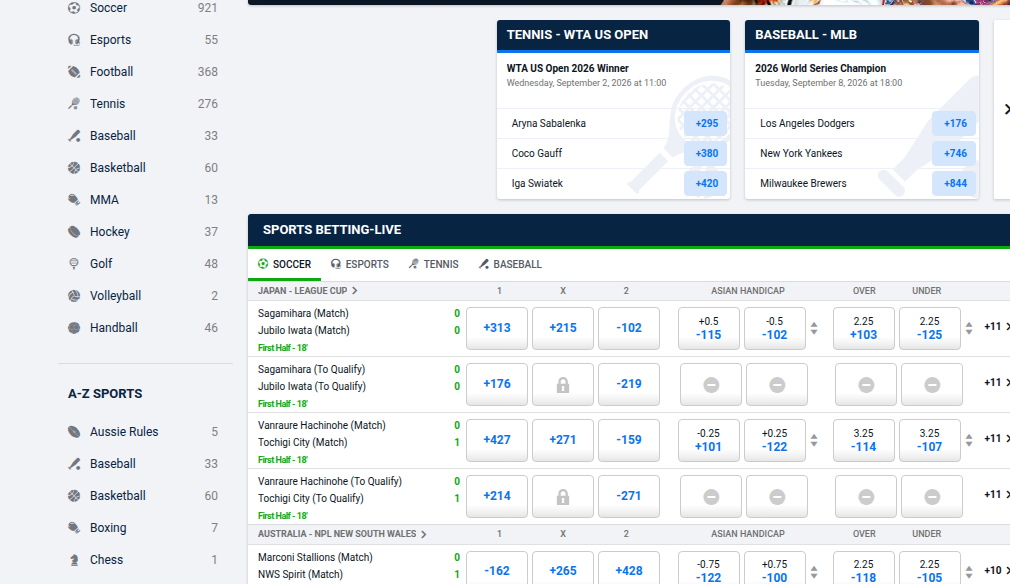
How in-play pricing, delays and cash out actually work is covered on our live betting in Ontario page.
Betting Markets and Odds
Odds are the price attached to a market, not a separate thing from it. The same event carries different odds in different markets, because each market asks a different question.
Prices move for two reasons: the event changes, or the money does. A lineup announcement moves a player prop; heavy one-sided betting moves a spread. In play, both happen at once.
Specific markets usually carry a wider margin than main ones. A moneyline is priced tightly because everyone bets it and the sportsbook is confident in the number; an obscure player prop carries more cushion because neither is true.
There is a practical consequence. The deeper you go into a board — from the moneyline to a player prop to a leg of a same-game parlay — the more of the price is margin rather than probability. Depth is a feature, but it is not free.
Reading the Margin
Convert every price in a market to implied probability and add them up. A two-way market that totals 105% carries five points of margin; one that totals 112% carries twelve. That sum is the single most useful comparison between two Ontario boards on the same fixture, and it is the reason a bigger number on the screen is not automatically a better bet.
Betting Markets Available in Ontario Sportsbooks
Which markets you can reach depends on more than the sportsbook.
Which operators are registered in Ontario, and how they compare across the board, is on our Ontario sportsbooks page; the ranked comparison sits on best Ontario sportsbooks.
How to Choose a Betting Market
There is no best market. There is the market that matches what you actually think will happen.
| If your view is… | The market is |
| This side wins | Moneyline |
| This side wins comfortably, or loses narrowly | Point spread or handicap |
| The game will be high or low scoring | Totals, over or under |
| This player will have a big game | Player props |
| This team performs, whatever the result | Team props |
| This will be true at the end of the season | Futures |
| Several of the above, at a longer price | Parlay |
Betting Markets by League
Ontario boards organise markets by competition, and depth follows attention. The NHL, NBA, MLB and NFL carry the widest market lists in North American sport, with the CFL priced alongside them.
In soccer, the Premier League and the UEFA Champions League are the deepest, with MLS the domestic anchor through the Canadian summer. In tennis, the ATP and WTA tours run almost year-round, which is why tennis so often leads an in-play board.
The pattern is consistent: the more a competition is watched, the more questions a sportsbook is willing to price on it.
The difference is measurable rather than impressionistic. On one ordinary MLB fixture we counted around 400 markets at NorthStar Bets and 275 at BetVictor, while bet365 builds parlays up to 12 legs.
Legal Betting Markets in Ontario
Every market described here is offered by sportsbooks registered with iGaming Ontario and regulated by the AGCO. Registration is what makes a market legal, and it is also what removes some of them — the prohibitions above come from the same rulebook.
The register, the registration numbers and what the standards require are on our legal sports betting page. The provincial picture by sport is on our Ontario sports betting hub, and the apps that carry these markets on our betting apps page.
The prohibitions have teeth. Standard 4.34 bars betting on Canadian minor league sport, including the CHL, and on 20 June 2023 the AGCO issued $15,000 penalties to two registered operators for taking bets on the OHL, WHL and QMJHL during the 2022-23 season.
Betting Responsibly
More markets means more decisions, and player props and parlays are the two that most invite repeat betting. That is worth naming.
Every registered Ontario sportsbook must offer deposit, loss and time limits, plus self-exclusion, and must let you set them before you need them.
Frequently Asked Questions
- What are betting markets?
A betting market is the specific question you are betting on within an event. One game carries many markets: who wins, the winning margin, the total score, and what individual players do. The event is the match; the market is the question.
- What are the most common sports betting markets?
Moneyline, point spread or handicap, and totals. Those three appear on every registered Ontario sportsbook in every sport with a scoreline. Player props, team props, futures and parlays account for most of the rest.
- What is a moneyline bet?
A bet on which side wins outright, with no handicap. The favourite returns less than your stake in profit, the underdog more. In soccer the same market is three-way, because a draw is a possible result.
- What is a point spread?
A handicap applied to the favourite so both sides sit at a similar price. A team at -6.5 must win by seven or more to cover. Hockey and baseball use the same idea as the puck line and run line, set at 1.5.
- What are player props?
Bets on what one named player does — goals, points, assists, shots, rebounds or touchdowns — regardless of the result. They vary more between sportsbooks than any other market, and they are the first to disappear once a game starts.
- Do all Ontario sportsbooks offer the same betting markets?
No. On an ordinary game we have counted from around 110 markets at one Ontario book to roughly 400 at another. Depth also depends on the sport, the competition and whether the event has started.
- Are betting markets available for live betting?
Yes, but the list is much shorter. One Ontario board that carried about 400 markets before the game dropped to 15 or 18 once play began, as props settled or suspended. New in-play markets such as next goal then appear.
- Are there betting markets Ontario does not allow?
Yes. The Registrar’s Standards prohibit bets on financial markets, anything mimicking a financial instrument, lottery outcomes, settled events, and Canadian minor-league sport. That last rule is why the OHL cannot be bet on in Ontario.