
Arbitrage Calculator: 2-Way and 3-Way Arb Stakes and Profit


This arbitrage calculator checks whether the best prices on a 2-way or 3-way market add up to under 100% and splits your stake so every result returns the same.
| Outcome | Best odds | Sportsbook (optional) | Stake | Returns |
|---|---|---|---|---|
| Outcome 1 | – | – | ||
| Outcome 2 | – | – |
Enter the best price on each outcome, from whichever Ontario books offer them. The stakes are set so every outcome returns the same amount.
19+. For information only. Prices move in seconds and a bet is only placed when the sportsbook accepts it – check both prices are still available before placing either bet.
How to Use the Arbitrage Calculator
- Pick the market type and odds format. 2-way is for money lines that include overtime, spreads, totals and tennis; 3-way adds a draw line for soccer results and 60-minute hockey lines. Switching between American and decimal converts what you have typed.
- Enter the best price on each outcome, from whichever books offer them, and your total stake. The book’s name is optional and goes into the betting plan.
- Choose the split and the rounding: an equal return, the profit on one outcome only, or cover for a bet already placed – rounded to $1 or $5, as arbs are placed in practice.
- Read the result. Under 100% combined, every outcome returns more than you staked and the plan lists each bet; over 100%, the calculator shows how much the books keep.
How Arbitrage Works: The Formula
An arbitrage bet backs every outcome of the same event at different sportsbooks. Every sportsbook builds a margin into its prices, so at one book the implied chances of all outcomes always add up to more than 100%. Across several books, though, each outcome can be taken at whichever book prices it best. If one book is slow to move a line, or two books disagree about a game, the best prices together can add up to less than 100% – and the gap is a profit that does not depend on the result. The calculation takes five steps:
| Step | Formula | Example: +120 and -110 |
|---|---|---|
| Implied chance of each price | 1 / decimal odds | 1/2.20 = 45.45%; 1/1.909 = 52.38% |
| Combined | Sum of the implied chances | 97.84% – below 100%, so it is an arb |
| Stake on each outcome | Total x implied chance / combined | $100 x 45.45 / 97.84 = $46.46; $53.54 on the other |
| Return either way | Total / combined | $100 / 0.9784 = $102.21 |
| Profit | Return – total | $2.21, or 2.21% |
Below 100% combined, an equal split returns more than the total staked on every outcome; at 100% or above, no split of the stake can do that.
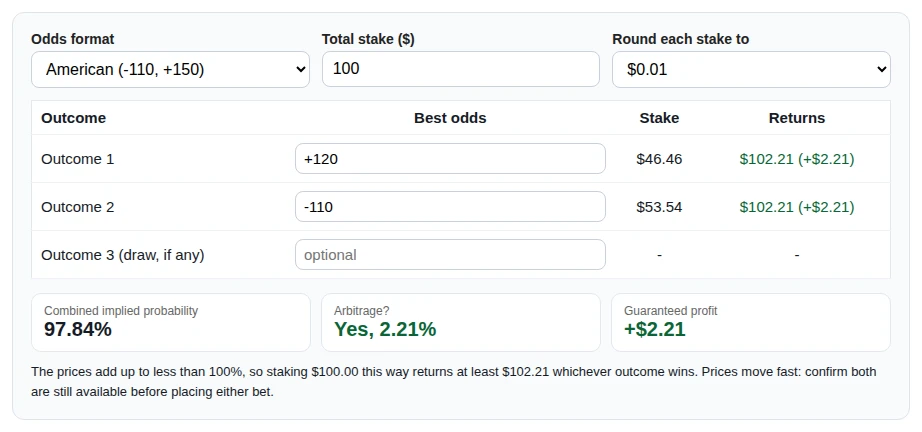
The +120 / -110 example is illustrative: a gap that wide between two books on the same game is unusual, and does not last long when it appears.
Arbitrage Percentage and Profit
The further below 100% the combined price, the bigger the profit. This is what each level returns before rounding:
| Combined implied probability | Profit | On $100 | On $500 | On $1,000 |
|---|---|---|---|---|
| 99.5% | 0.50% | $0.50 | $2.51 | $5.03 |
| 99.0% | 1.01% | $1.01 | $5.05 | $10.10 |
| 98.5% | 1.52% | $1.52 | $7.61 | $15.23 |
| 98.0% | 2.04% | $2.04 | $10.20 | $20.41 |
| 97.5% | 2.56% | $2.56 | $12.82 | $25.64 |
| 97.0% | 3.09% | $3.09 | $15.46 | $30.93 |
| 95.0% | 5.26% | $5.26 | $26.32 | $52.63 |
Most arbs that appear between regulated books sit in the first three rows. The profit is the total stake divided by the combined probability, minus the stake – so a 1% arb on $100 is $1.01, and doubling the stake is the only way to double the profit. That is exactly where stake limits bite.
Three-Way Arbitrage Calculator
Markets with a draw – soccer match results, or hockey settled at the end of regulation time – need three bets instead of two. Select 3-way (with draw) in the calculator at the top of this page and a draw line appears between the two teams. The calculation is the same as for two outcomes, with one more term:
| Step | Formula | Example: 2.30, 3.70 and 3.60 |
|---|---|---|
| Implied chance of each price | 1 / decimal odds | 43.48%, 27.03% and 27.78% |
| Combined | Sum of the three | 98.28% – below 100%, so it is an arb |
| Stake on each outcome | Total x implied chance / combined | $44.24, $27.50 and $28.26 on $100 |
| Return whatever happens | Total / combined | About $101.75: +$1.75 |
As with two outcomes, each result returns the total stake divided by the combined figure, so the draw pays exactly what either win pays.
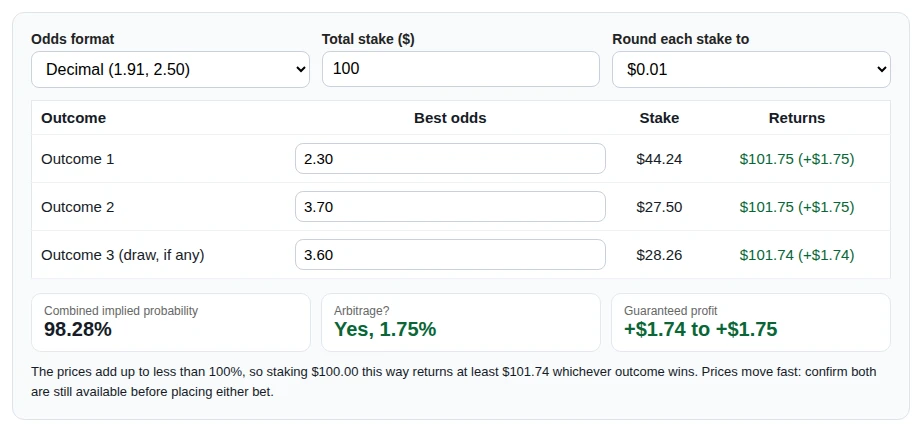
Three prices have to be out of line at once, so three-way arbs are rarer than two-way ones, and the margin on a draw market is usually wider than on a two-way line.
What a 60-Minute (3-Way) Money Line Is
A hockey money line normally includes overtime and the shootout, so there are only two results. The 60-minute line – also called the 3-way or regulation-time money line – is settled when the third period ends: if the score is level after 60 minutes, the bet on the draw wins and both team bets lose, whoever wins in overtime. Every Ontario book that offers it names it differently: NorthStar Bets and BetRivers call it “60 Mins Line”, FanDuel “60 Min Moneyline (3 Way)”, 888sport “Money Line (No OT)”, and Pinnacle lists it under regulation time. A tie after 60 minutes is common: NorthStar Bets’ prices for the four games of 27 October gave it between 22% and 24% in each.
The Trap: Mixing a 60-Minute Price With a Money Line
The commonest three-way mistake looks like a large arb. Take the Golden Knights on the 60-minute line at NorthStar Bets (+107) and the Senators on the money line at Pinnacle (+132), and enter them in 2-way mode: they add up to 91.41%, and the calculator shows a profit of about $9 on $100. It is not an arb, because the two bets settle on different things. With $52.85 on the Golden Knights and $47.15 on the Senators:
| How the game ends | Result on $100 | Why |
|---|---|---|
| Golden Knights win in regulation | +$9.40 | Your 60-minute bet wins |
| Tied after 60, Senators win in overtime or shootout | +$9.39 | The money line includes overtime |
| Senators win in regulation | +$9.39 | The money line wins |
| Tied after 60, Golden Knights win in overtime or shootout | -$100.00 | The 60-minute bet loses on the tie, the Senators money line loses on the result |
One of the four endings loses the whole stake, and with a tie after 60 minutes priced at about 22%, and roughly half of those ties won by Vegas, that ending is far from rare. Every price in a three-way calculation has to come from the same three-way market: three 60-minute prices, or three full-time soccer prices.
Soccer: Home, Draw, Away
Soccer’s match result market is three-way everywhere, settled after 90 minutes plus stoppage time, so enter the best home, draw and away prices from that full-time market. Each book prices the three results separately, and the best price on each is often at a different book.
A double chance price covers two of the three results at once, so it can stand in for two of the three bets: the home win against “draw or away” is a two-way calculation. Draw no bet is different: it refunds the stake on a draw instead of winning or losing, so it never goes into a three-way calculation. In a cup tie, the 90-minute result and the “to qualify” market settle on different things, so they cannot be mixed either.
A Real Arbitrage Example From Ontario Books
On 27 October 2026 we took the best money-line price on each team across 14 Ontario sportsbooks for the four NHL games that night – the most favourable combination possible:
| Game | Best price, home team | Best price, visitors | Combined | Result on $100 |
|---|---|---|---|---|
| Blue Jackets at Flyers | +105 / 2.05 (eight books) | -118 / 1.85 (Pinnacle) | 102.91% | -$2.83 |
| Kings at Blackhawks | +104 / 2.04 (Pinnacle) | -115 / 1.87 (theScore Bet) | 102.51% | -$2.45 |
| Panthers at Jets | +113 / 2.13 (Pinnacle) | -125 / 1.80 (NorthStar Bets, Betway) | 102.50% | -$2.44 |
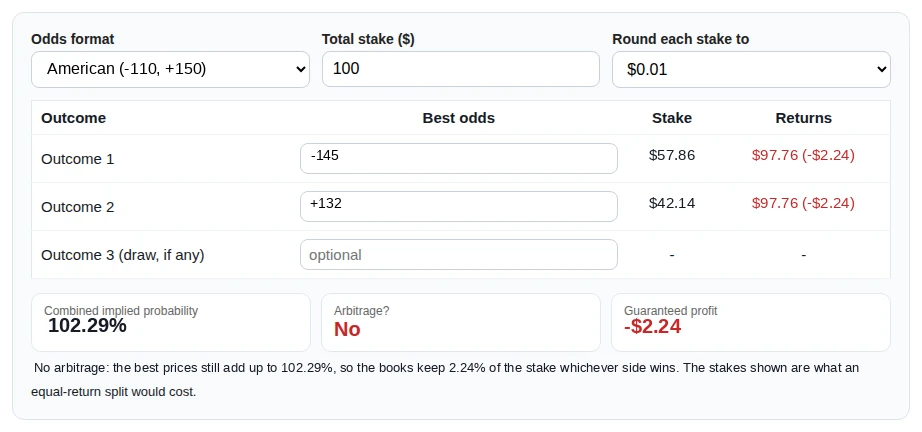
| Senators at Golden Knights | -145 / 1.69 (theScore Bet) | +132 / 2.32 (Pinnacle) | 102.29% | -$2.24 |
None was an arb. The closest, Senators at Golden Knights, paired theScore Bet‘s -145 on Vegas with Pinnacle’s +132 on Ottawa: 59.18% + 43.10% = 102.29%, so the books still kept $2.24 of every $100. The two books leaned different ways, but by less than their own margins on that game, 2.9% at Pinnacle and 3.6% at theScore Bet – an arb needs a book to be wrong in your favour by more than that.
The nearest thing to an arb on the board was a puck line: the Panthers -1.5 at ToonieBet (+205) and the Jets +1.5 at FanDuel (-220) added up to 101.54%. The best 60-minute prices at four books ran from 102.76% to 103.29%, and Pinnacle kept 5.8% on the 60-minute line against 2.9% on the money line. Betinia, ToonieBet and DAZN Bet posted identical prices on every line: sister brands never arb each other.
Our NHL odds page tracks the best price on each game, and the Sportsbook Margin Index shows what each Ontario book keeps.
Choosing How to Split the Stake
An arb does not have to pay the same on every result. The calculator offers three splits, shown here on the example in the calculator, +120 and -110 with $100:
| Split | Stakes | Result |
|---|---|---|
| Equal return | $46.46 at +120, $53.54 at -110 | +$2.21 whichever side wins |
| Profit on outcome 1 only | $47.62 at +120, $52.38 at -110 | +$4.76 if outcome 1 wins, $0.00 if outcome 2 wins |
| Already bet on outcome 1 ($50 at +120) | $57.62 at -110 | +$2.38 whichever side wins, on $107.62 staked |
Equal return is the classic arb. Profit on one outcome only stakes just enough on the others to get your money back if they win, and puts the rest where you think the price is best – the profit is bigger but no longer guaranteed. Already bet on outcome 1 is for when one price was taken first: it works out what the other bets must be for every result to return the same, which is also how a hedge is sized. In 3-way mode the same choices cover the draw.
Rounding the Stakes
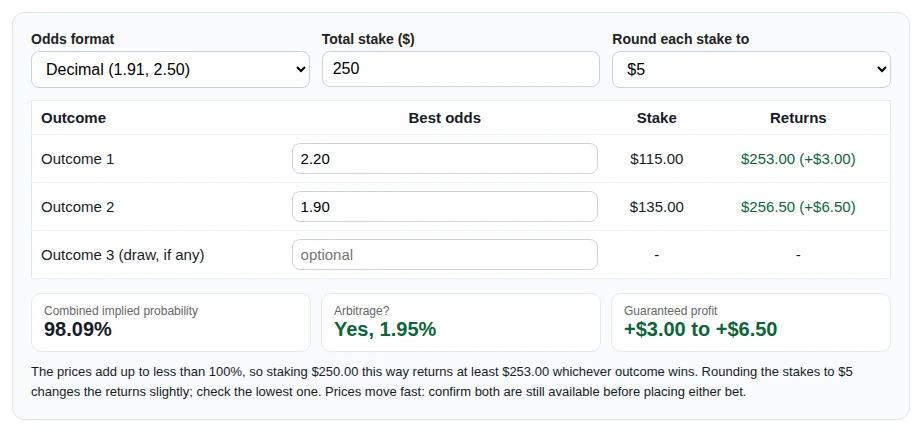
Exact arb stakes come out in cents – $46.46 and $53.54. Placing odd amounts repeatedly is a pattern sportsbooks notice, and rounding them changes the result. The calculator rounds to $1 or $5 and shows the return on each outcome after rounding, which is no longer identical: the profit becomes a range, and the lowest figure is the one that counts.
Spreads and Totals: Same Line or It Is Not an Arb
An arb on a spread or a total needs the same line at both books: over 5.5 at one and under 5.5 at the other. If one book has 5.5 and the other 6.5, the two bets do not cover every result – there is a score where one wins and the other loses, or where both win. That second case is a middle, the bonus outcome described in our hedge calculator guide, and it is a different bet with a different risk: if the game lands outside the gap, one bet loses outright.
Half-point lines matter. A total of 6 can push, returning the stake, while 5.5 cannot; pairing a whole-number line with a half-point line leaves a result where one bet is refunded and the other is settled. Enter only prices for the same line in the calculator.
Live Arbitrage
In-game prices move after every goal, run or possession, and two books rarely update at the same instant, so brief gaps appear more often live than before the game. They are also the hardest to take. Ontario books suspend markets for several seconds after key moments and may hold a bet for a short delay before accepting it; by the time the second bet goes through, the first price has often gone. Live margins are usually wider than pre-match ones as well, so a live gap has to be larger to be an arb at all. Our live betting guide explains how in-game markets are run.
Where Arbs Tend to Appear
- Newly posted lines. When a book opens a market, its first price can differ from the market’s for a short time.
- After news. An injury or a goalie change moves sharp books first; slower books can be out of line for a few minutes.
- Player props and smaller leagues. Books price these with less attention and less agreement, so they disagree more often – and limit stakes on them sooner.
- Between a low-margin book and a high-margin one. The gap is easiest to find where one book’s price is close to fair and the other’s is not, which in our samples meant pairing a book from the top of our margin index with one from the bottom.
- Not in futures. Outright markets spread the margin over dozens of prices: on 27 October 2026 the Stanley Cup winner market added up to 125.0% at FanDuel and 127.7% at NorthStar Bets and BetRivers, and the best price on every team across the three still came to 123.5%. Our futures guide explains their margins.
In each case the window is short. A price that looks like an arb an hour after it appeared has usually been corrected, or will be voided under an obvious-error rule.
How to Place an Arb, Step by Step
- Confirm the market is identical: same event, same line, same settlement rule – including overtime.
- Run the prices through the calculator with the rou