
Kelly Criterion Calculator: How Much to Bet on Each Edge


This Kelly criterion calculator works out how much of your bankroll to stake on a bet from its odds and your chance of winning – and when not to bet.
Enter the odds you can bet at, your own estimate of the chance of winning, and your bankroll – the money you have set aside for betting. Kelly stakes nothing unless the chance you enter is higher than the chance the odds imply.
19+. For information only: the stake is only as good as the chance you enter, and no stake removes the risk of losing a bet.
How to Use the Kelly Criterion Calculator
- Enter the odds you can bet at – American, decimal or fractional. Switching the format converts what you have typed.
- Enter your chance of winning, as a percentage. It is your own estimate, not the chance the odds imply. If you use a sharp book’s prices as your estimate, type both of its prices in the optional fields and press Use the fair chance.
- Enter your bankroll – the money you have set aside for betting, not your savings.
- Choose the Kelly fraction: full, half, quarter, or any share of the full stake.
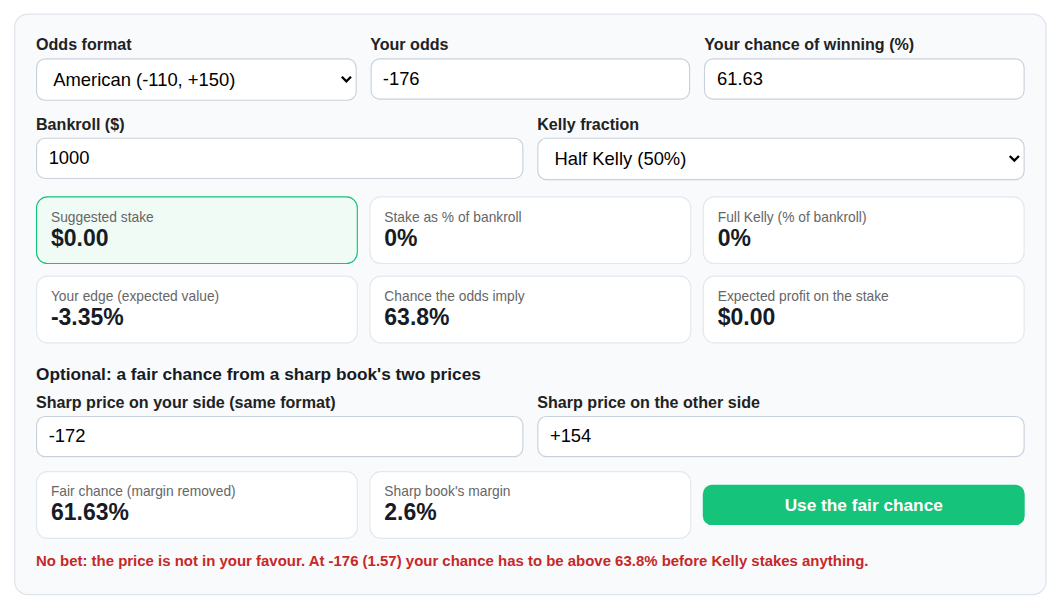
- Read the suggested stake. If your chance is no higher than the chance the odds imply, the calculator says No bet: the price is not in your favour and stakes $0.
The default example – +150 with a 45% chance and a $1,000 bankroll – gives an edge of 12.5%, a full Kelly stake of 8.33% of the bankroll and a half Kelly stake of $41.67.

What Is the Kelly Criterion?
The Kelly criterion is a formula for how much to bet: stake the share of your bankroll equal to your edge divided by the net odds. Over many bets it grows a bankroll faster than staking any other fixed share, and it stakes nothing when the price is not in your favour.
It comes from a 1956 paper by John L. Kelly Jr., a researcher at Bell Labs, “A New Interpretation of Information Rate“, published in the Bell System Technical Journal. Kelly imagined a gambler receiving tips over a noisy private wire. Betting everything on every tip maximizes the average result, but the paper shows such a gambler “would be broke with probability one” if he kept going; betting a fixed fraction of his capital each time – on even-money bets, his chance of winning minus his chance of losing – makes the money grow fastest instead. Edward Thorp later used the same rule to size blackjack bets, and it has been part of sports betting and investing ever since.
Three Things the Kelly Stake Always Does
- It is a share, not an amount. After a loss the bankroll is smaller and so is the next stake; after a win, both grow.
- It is zero without an edge. If your chance is no better than the price implies, Kelly bets nothing.
- It never stakes the whole bankroll on a bet that can lose, so a run of losses shrinks the bankroll but cannot wipe it out.
Kelly Criterion Stake Chart: Full and Half Kelly
Kelly depends on two numbers: your edge – your chance times the decimal odds, minus 1 – and the odds themselves. This chart gives the full Kelly stake and the half Kelly stake, as a share of the bankroll, for common prices and edges:
| Odds | Decimal | 1% edge | 2% edge | 5% edge | 10% edge |
|---|---|---|---|---|---|
| -200 | 1.50 | 2.0% / 1.0% | 4.0% / 2.0% | 10.0% / 5.0% | 20.0% / 10.0% |
| -150 | 1.67 | 1.5% / 0.8% | 3.0% / 1.5% | 7.5% / 3.8% | 15.0% / 7.5% |
| -110 | 1.91 | 1.1% / 0.6% | 2.2% / 1.1% | 5.5% / 2.8% | 11.0% / 5.5% |
| +100 (EVEN) | 2.00 | 1.0% / 0.5% | 2.0% / 1.0% | 5.0% / 2.5% | 10.0% / 5.0% |
| +130 | 2.30 | 0.8% / 0.4% | 1.5% / 0.8% | 3.8% / 1.9% | 7.7% / 3.8% |
| +150 | 2.50 | 0.7% / 0.3% | 1.3% / 0.7% | 3.3% / 1.7% | 6.7% / 3.3% |
| +200 | 3.00 | 0.5% / 0.3% | 1.0% / 0.5% | 2.5% / 1.3% | 5.0% / 2.5% |
| +300 | 4.00 | 0.3% / 0.2% | 0.7% / 0.3% | 1.7% / 0.8% | 3.3% / 1.7% |
| +500 | 6.00 | 0.2% / 0.1% | 0.4% / 0.2% | 1.0% / 0.5% | 2.0% / 1.0% |
The same edge earns a much bigger stake on a favourite than on a long shot: a 2% edge is worth 4.0% of the bankroll at -200 but 0.4% at +500, because Kelly divides the edge by the net odds – and a long shot loses more often, so it gets less of the bankroll. To read a stake for a $1,000 bankroll, move the decimal point: 4.0% is $40.
The Kelly Criterion Formula
f* = (bp – q) / b
where f* is the share of the bankroll to stake, b is the net odds (decimal odds minus 1), p is your chance of winning and q = 1 – p is your chance of losing. The same formula, written with the edge, is f* = (p x decimal odds – 1) / (decimal odds – 1).
For American odds, b is the odds divided by 100 for a plus price (+150 gives b = 1.5) and 100 divided by the odds for a minus price (-157 gives b = 0.637).
A Kelly Calculation by Hand
At +150 with a 45% chance: b = 1.5, so f* = (1.5 x 0.45 – 0.55) / 1.5 = 0.125 / 1.5 = 8.33%. On a $1,000 bankroll that is $83.33, or $41.67 at half Kelly. The break-even chance at +150 is 1 / 2.50 = 40%: below it, bp – q turns negative and the stake is zero.
The formula comes from maximizing the average logarithm of the bankroll after a bet, p x ln(1 + bf) + q x ln(1 – f). That is why Kelly is a growth rule: it makes the typical bettor’s bankroll grow fastest, not the average one.
Why Most Bettors Use Fractional Kelly
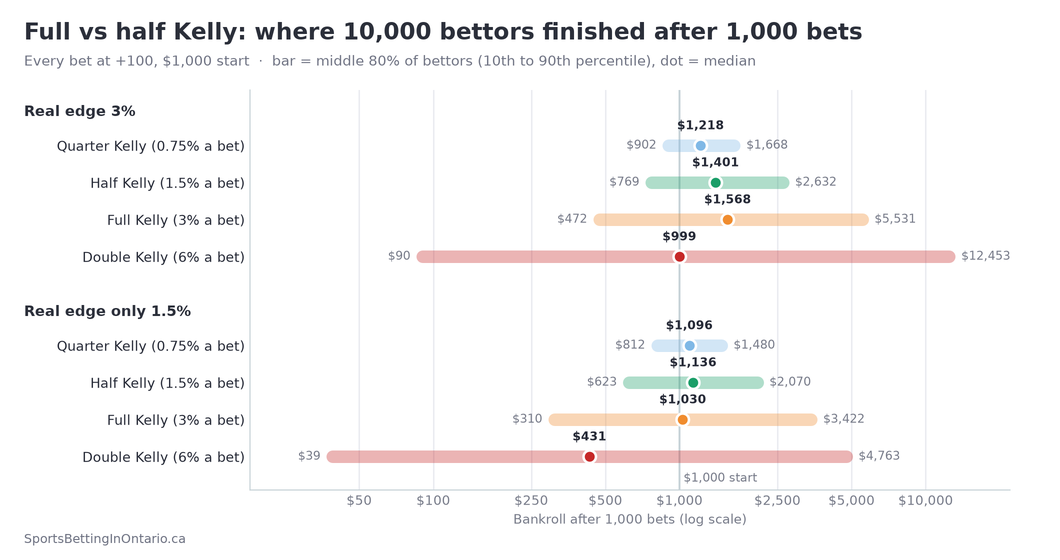
Full Kelly grows a bankroll fastest, but with big swings along the way. To show how big, we simulated 10,000 bettors, each starting with $1,000 and making 1,000 bets at +100 with a true 51.5% chance – a 3% edge, for which full Kelly is 3% of the bankroll. Each rule stakes a fixed share of the current bankroll, with no minimum bet or rounding:
| Stake rule | Stake per bet | Median bankroll after 1,000 bets | 1 in 10 finished below | Fell to $500 at some point | Typical worst drop from a peak |
|---|---|---|---|---|---|
| Quarter Kelly | 0.75% | $1,218 | $902 | under 0.1% | 18% |
| Half Kelly | 1.5% | $1,401 | $769 | 4% | 34% |
| Full Kelly | 3.0% | $1,568 | $472 | 29% | 59% |
| Double Kelly | 6.0% | $999 | $90 | 70% | 88% |
Half Kelly kept 71% of full Kelly’s median gain ($401 against $568), while the share of bettors who fell to half their starting bankroll dropped from 29% to 4%. Double Kelly took far more risk and the typical bettor finished where they started, $999.
When the Edge Is Smaller Than You Think
The bigger reason for a fraction is that nobody knows their real chance. Here the same bettors believe they have a 3% edge and stake the same shares, but the true chance is 50.75% – an edge of only 1.5%, for which the right full Kelly stake is 1.5%:
| Stake rule | Stake per bet | Median if the edge is 3% | Median if the edge is 1.5% | Fell to $500 (edge 1.5%) |
|---|---|---|---|---|
| Quarter Kelly | 0.75% | $1,218 | $1,096 | under 0.1% |
| Half Kelly | 1.5% | $1,401 | $1,136 | 9% |
| Full Kelly | 3.0% | $1,568 | $1,030 | 45% |
| Double Kelly | 6.0% | $999 | $431 | 82% |
With the edge overestimated by half, “full Kelly” is really double Kelly: the median bettor finished at $1,030 and 45% fell to $500 at some point. Half Kelly became the true Kelly stake and finished best, at $1,136. A fraction of Kelly costs a little growth when your estimate is right and protects you when it is wrong.
Where the Winning Chance Comes From
The formula is the easy part. Kelly assumes you know your chance of winning, and the stake is only as good as that number: overestimate it and Kelly tells you to overbet.
The most reliable reference is a sharp book’s price with the margin removed. Pinnacle is licensed in Ontario, takes large bets from sharp bettors and keeps the lowest margins of the books on our Sportsbook Margin Index, so its prices are the closest thing to a market consensus. Divide 1 by each side’s decimal odds, add the two chances, and divide each by the total: what is left is the fair chance. The calculator’s optional fields do this for you, and the odds calculator does it for any market.
A Kelly-Like Rule in Our NHL Picks
Our NHL picks use exactly this method every day: Pinnacle’s fair line against the best price at other Ontario books. Their staking rule works like a capped fraction of Kelly: one unit for an edge above +2%, half a unit at most below +1%, with a unit commonly set at 1% of the bankroll. For a +2% edge at +100, full Kelly is 2% of the bankroll, so one unit is half Kelly. The cap keeps big edges, where the estimate is least reliable, from turning into big stakes, and Pinnacle’s own line has a margin of error wider than 1%.
A Real Kelly Stake From Ontario Books
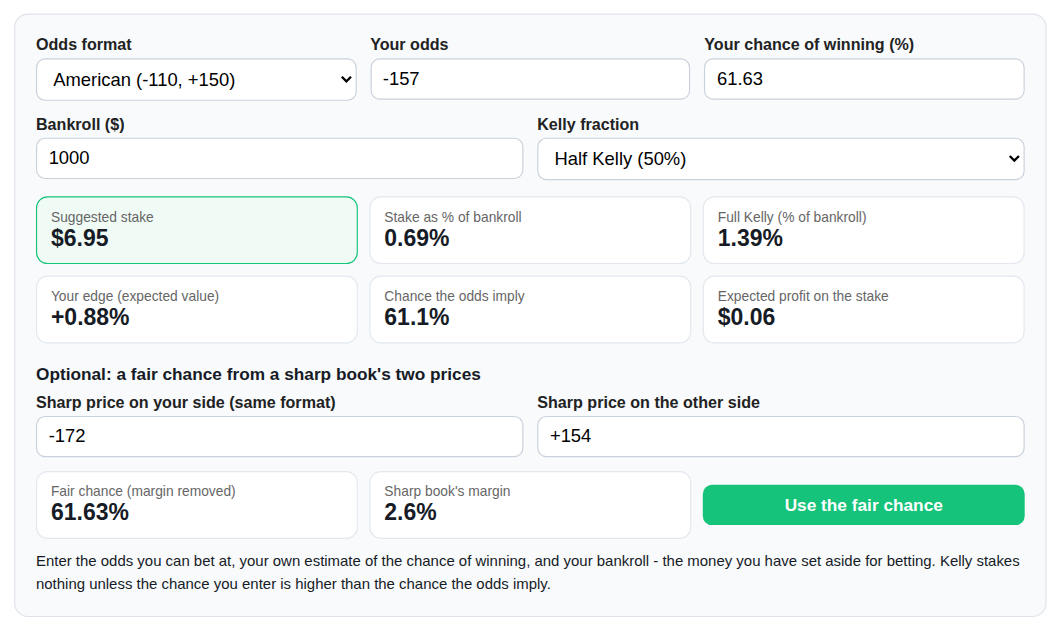
On 1 November 2026, NorthStar Bets had the Utah Mammoth at -157 (1.637) to beat the Flyers in Philadelphia, overtime included. Pinnacle had Utah at -172 and Philadelphia at +154, a 2.6% margin; with it removed, Utah’s fair chance was 61.63%, a fair price of -161.
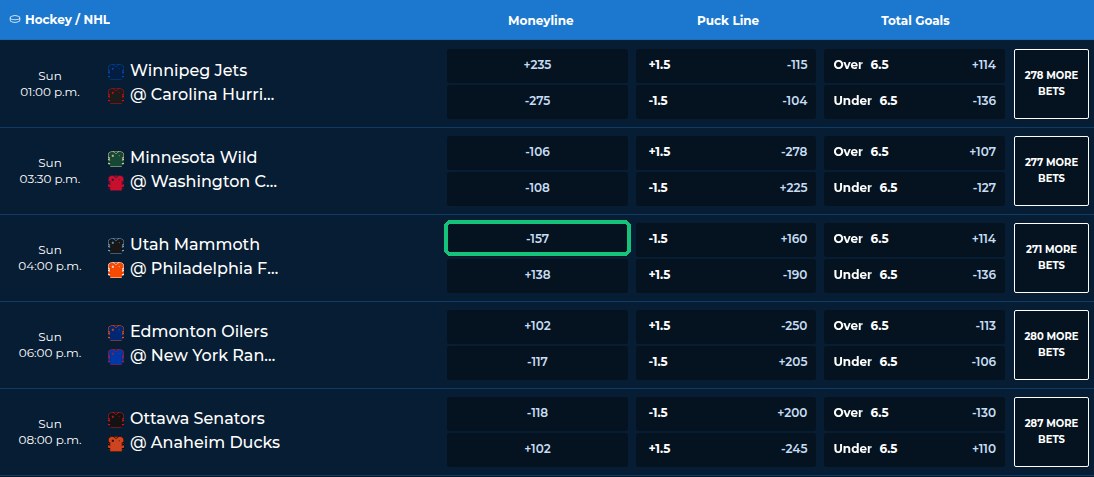
At -157 that is an edge of 0.6163 x 1.6369 – 1 = +0.88% – the +0.9% half-unit lean on our NHL picks page that day – and a full Kelly stake of (0.6369 x 0.6163 – 0.3837) / 0.6369 = 1.39% of the bankroll. On $1,000:
| Stake rule | Share of the bankroll | Stake on $1,000 | Expected profit |
|---|---|---|---|
| Full Kelly | 1.39% | $13.89 | $0.12 |
| Half Kelly | 0.69% | $6.95 | $0.06 |
| Quarter Kelly | 0.35% | $3.47 | $0.03 |
| Our NHL picks lean: half a unit, with a unit at 1% | 0.50% | $5.00 | $0.04 |
Kelly turns a thin edge into a small stake: under $14 even at full Kelly. At every other Ontario book we read the same bet was below fair – BetRivers at -162 (-0.3%), FanDuel at -176 (-3.4%) – and there Kelly stakes nothing. Current prices are on our NHL odds today page.
Kelly for Parlays and Several Bets at Once
Parlays. Treat a parlay as one bet: its decimal odds are the product of the legs’ odds and, if the legs are independent, its chance is the product of their chances. Two -110 legs with a 2% edge each make a parlay at 3.64 with a 4.04% edge, yet Kelly stakes only 1.53% of the bankroll on it, against 2.2% on each leg as a single – longer odds, more variance. A parlay only has an edge if the edges hold up when multiplied: add a -110 leg whose fair chance is 50% (an edge of -4.5%) to a +2% leg and the ticket is at -2.6%. Same-game legs are correlated, so multiplying their chances gives the wrong number – do not size a same game parlay with Kelly. Our parlay calculator shows how the margin multiplies too.
Several bets at the same time. On independent games the stakes barely change: with ten even-money bets at a 3% edge running at once, the stake that maximizes growth is 2.98% each instead of 3%. What changes is the total at risk – almost 30% of the bankroll in play at once. Size every bet from the bankroll before the day’s bets, and count two bets on the same game, such as a money line and a puck line on the same team, as one position.
Common Kelly Criterion Mistakes
- Overestimating the chance. The most common and the most expensive: Kelly multiplies any error in your estimate, and a stake twice the true Kelly stake leaves the typical bankroll with no growth at all.
- Using the odds’ own implied chance. Kelly then always says zero – the edge has to come from a chance that differs from the price.
- Staking the same dollars after losses. Kelly is a share of the current bankroll. Keeping a $50 stake after the bankroll has fallen from $1,000 to $600 is overbetting.
- Counting all your money as the bankroll. The bankroll is only what you have set aside for betting and can afford to lose.
- Rounding up. When Kelly says $6.95, betting $10 is 1.4 times the stake; round down.
- Chasing a big edge. An edge of 10% or more on a main market at a regulated book is far more likely to be a mistake in your number than in the book’s.
Kelly Staking and Responsible Gambling
Kelly maximizes long-run growth only for a bettor who really has an edge, and even then the swings are large: in our simulation, 29% of full Kelly bettors with a genuine 3% edge fell to half their bankroll at some point. Most bettors do not have an edge