
Hedge Calculator: How Much to Bet to Lock In a Profit


This hedge calculator shows how much to bet on the other side of a bet you already hold to lock in a profit or cut a loss.
| Hedge | Hedge stake | If the original bet wins | If the hedge wins |
|---|---|---|---|
| No hedge | $0.00 | – | – |
| Same result either way | – | – | – |
| Break-even (stake back if the original loses) | – | – | – |
| Your hedge stake | – | – | – |
Results are profit or loss on everything staked – the original bet plus the hedge. For a parlay with legs still to play, enter the ticket’s total payout and the odds against the last leg.
19+. For information only: the bet slips at your sportsbooks are what count. Prices move quickly, especially in-game – check the hedge price at the moment you place it.
How to Use the Hedge Calculator
- Choose American or decimal odds, whichever your sportsbook shows. Switching the menu converts what you have typed.
- Enter the original bet: the stake and the odds you got. For a parlay or any ticket where you already know the payout, type the total payout instead and the odds are ignored.
- Enter the hedge odds: the current price on the other side – the other team, the under instead of the over, or the field against your futures pick.
- Read the table. It shows three hedges side by side – one that pays the same either way, one that only gets your original stake back, and the stake you choose – as profit or loss on everything you staked.

The Hedge Formula, With Examples
A hedge is a second bet on the other side of a bet you already hold. To get the same result whichever side wins, the hedge has to pay out what the original bet would:
Hedge stake = potential payout of the original bet / decimal odds of the hedge
The potential payout includes the original stake – for a parlay, it is the total the ticket returns. The same formula covers the three situations where bettors hedge most:
| Situation | Original bet and payout | Hedge odds | Hedge stake | Result either way |
|---|---|---|---|---|
| Lock in a profit: a futures ticket that reached the final | $20 at +1200, pays $260.00 | -150 (1.667) | $156.00 | +$84.00 |
| Hedge the last leg of a parlay | $10 parlay, pays $120.00 | +110 (2.10) | $57.14 | +$52.86 |
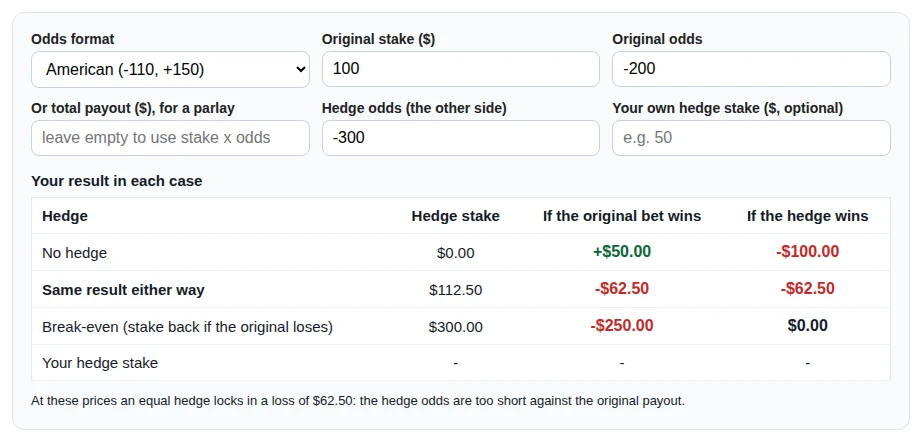
| Cut a loss: the game has turned against you | $100 at -200, pays $150.00 | -300 (1.333) | $112.50 | -$62.50 |
Whether a hedge locks in a profit or a loss depends only on how the price of the other side has moved since you bet: drifted out, as in the first two rows, it secures a profit; shortened, as in the last, it only caps the loss – at $62.50 instead of $100.
Hedge Stake Chart
The equal hedge is the payout multiplied by the hedge’s implied chance, so it can be read off a chart. This is the equal hedge for every $100 the original bet would pay, and the break-even hedge for every $10 you originally staked, at the common hedge prices:
| Hedge odds | Decimal | Equal hedge per $100 of payout | Break-even hedge per $10 staked |
|---|---|---|---|
| -300 | 1.33 | $75.00 | $30.00 |
| -250 | 1.40 | $71.43 | $25.00 |
| -200 | 1.50 | $66.67 | $20.00 |
| -175 | 1.57 | $63.64 | $17.50 |
| -150 | 1.67 | $60.00 | $15.00 |
| -130 | 1.77 | $56.52 | $13.00 |
| -120 | 1.83 | $54.55 | $12.00 |
| -110 | 1.91 | $52.38 | $11.00 |
| +100 (EVEN) | 2.00 | $50.00 | $10.00 |
| +110 | 2.10 | $47.62 | $9.09 |
| +120 | 2.20 | $45.45 | $8.33 |
| +130 | 2.30 | $43.48 | $7.69 |
| +150 | 2.50 | $40.00 | $6.67 |
| +175 | 2.75 | $36.36 | $5.71 |
| +200 | 3.00 | $33.33 | $5.00 |
| +250 | 3.50 | $28.57 | $4.00 |
| +300 | 4.00 | $25.00 | $3.33 |
Scale the chart to your ticket: a $260 payout hedged at -150 needs 2.6 x $60.00 = $156.00, as in the first example above. The shorter the hedge price, the more it takes to cover the same payout – at -300, three times as much as at +300.
The Three Hedges, and the Formula Behind Each
There are three ways to hedge, and each has a one-line formula:
| Hedge | Hedge stake | What it does |
|---|---|---|
| Same result either way | Original payout / hedge decimal odds | Locks in one profit (or one loss) whoever wins |
| Break-even | Original stake / (hedge decimal odds – 1) | Returns your original stake if the original bet loses, and keeps most of the upside if it wins |
| Partial | Anything in between | Trades some of the upside for some protection |
Only the first fixes a single result whoever wins; the break-even hedge protects just the stake, and a partial hedge sits anywhere between the two.
Same result either way
The full hedge. Whoever wins, you collect the same amount, so the bet is effectively settled the moment you place the hedge. It is the right choice when you want the result decided and nothing left to watch.
Break-even
The cheapest protection. It only covers what you staked, so if the original bet loses you are back where you started, and if it wins you keep most of the profit. It suits a ticket you still believe in but would hate to see finish at a loss.
Partial hedge
Any stake between the two. Enter it in the last field and the calculator shows both outcomes; the more you hedge, the closer the two numbers get.
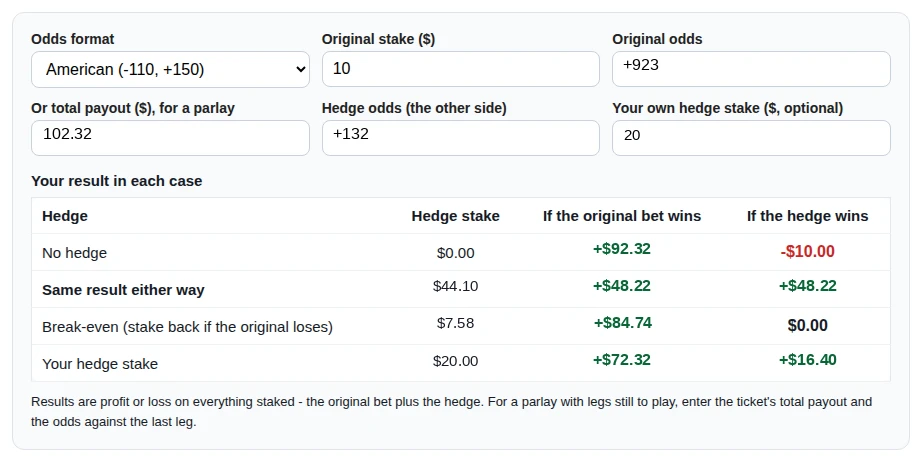
All three work on the payout, stake included, because that is what you collect if the original bet wins. The equal hedge sets the hedge payout equal to it; the break-even hedge sets the hedge’s profit equal to the original stake. If the equal-hedge profit comes out negative, the hedge price is too short to lock in a profit, and the calculator says so.
A Real Hedge Example From Ontario Books
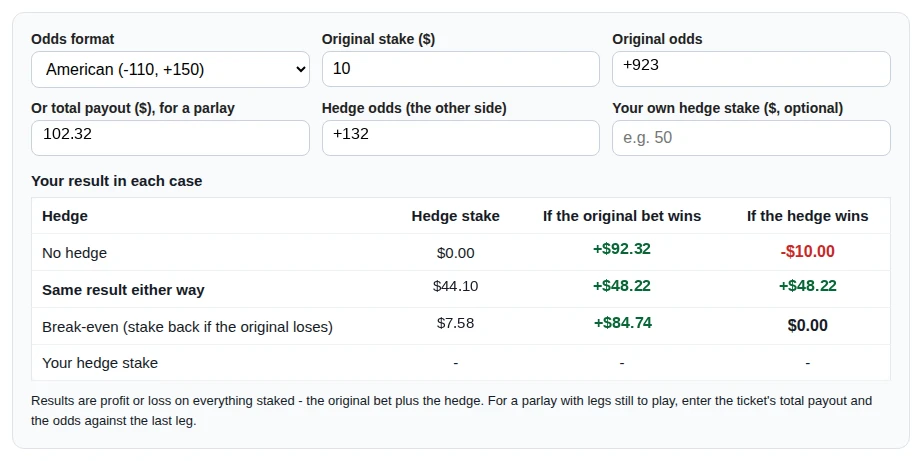
On 27 October 2026, the four NHL favourites at NorthStar Bets – the Blue Jackets at -120, the Kings at -118, the Panthers at -125 and the Golden Knights at -150 at home to the Senators – made a four-leg parlay paying $102.32 on a $10 stake. Say the first three won and only the Golden Knights were left. The best price on the Senators across the Ontario books we read was +132 (2.32), at Pinnacle:
| Choice | Hedge on the Senators | Golden Knights win | Senators win |
|---|---|---|---|
| No hedge | $0.00 | +$92.32 | -$10.00 |
| Same result either way | $44.10 | +$48.22 | +$48.22 |
| Break-even | $7.58 | +$84.74 | $0.00 |
The equal hedge, $102.32 / 2.32 = $44.10, turns a ticket that wins $92.32 or loses $10 into a sure +$48.22; the break-even hedge, $10 / 1.32 = $7.58, keeps +$84.74 if the Golden Knights win.
The hedge price mattered as well. Without the margin, the Senators’ chance – averaged over every book that priced the game – was 42.1%, so the $44.10 hedge at +132 cost about $1.05 on average; at Betano‘s +120, the worst price that night, the equal hedge would have cost about $3.46 and locked in $2.41 less. In practice a last-leg hedge is placed during the game at the live price, but the arithmetic is the same. Current prices are on our NHL odds page, and the Sportsbook Margin Index shows which books carry the lowest margins.
Example: Hedging a Futures Bet Before the World Series
Futures are where most hedges happen, because a ticket bought early can be worth far more by the end of the season. The 2026 World Series was Tampa Bay Rays v Milwaukee Brewers, and Milwaukee won it 4-1: 3-2 and 5-4 at home, 10-1 in Tampa on 26 October, a 4-3 loss in 12 innings on 27 October, then 4-1 in Game 5 on 28 October 2026.
On 19 October, with the American League pennant still being decided between the Rays and the Guardians, NorthStar Bets had the Brewers at -175 to win the World Series, the Rays at +175 and the Guardians at +1200 – three prices that add up to about 108%, because three teams were still alive. Suppose you took $20 on the Rays at +175 – a ticket that pays $55 if they win the World Series: the $20 back plus $35 profit.
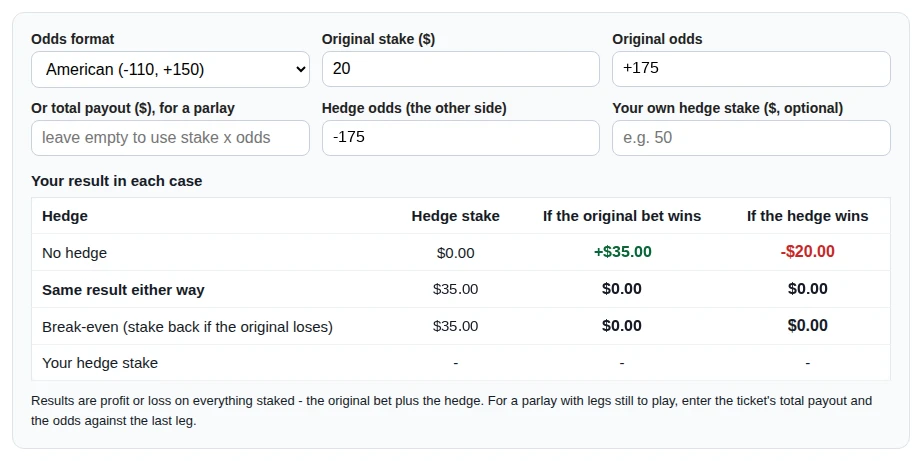
On 23 October, with the Rays through, NorthStar and BetRivers had the series at Brewers -175, Rays +145. The Brewers’ price had not moved, and that decides what a hedge can lock in. In decimal, +175 is 2.75 and -175 is 1.571, so the equal hedge is $55 / 1.5714 = $35.00, and the break-even hedge is $20 x 175 / 100 = $35.00 as well:
| What happens | Without a hedge | With $35.00 on the Brewers | With $17.50 on the Brewers (half) |
|---|---|---|---|
| Rays win the World Series | +$35.00 | $0.00 | +$17.50 |
| Brewers win the World Series | -$20.00 | $0.00 | -$10.00 |
Both full hedges turn a ticket that wins $35.00 or loses $20.00 into exactly $0.00 either way, while the half hedge leaves +$17.50 or -$10.00.
Why the Hedge Only Returns the Stake
The equal hedge and the break-even hedge are the same bet here. That is not a coincidence: a ticket at +175 hedged at -175 is a mirror image, so the two bets cancel out and all that is left is your stake back.
A hedge only locks in a profit when the other side’s price has drifted out since you bet – here, if the Brewers had become longer than -175. With the Brewers unchanged, the full hedge buys certainty and nothing more, and it also pays the margin in the series price – about 4.4% on 23 October (63.6% + 40.8% = 104.4%) – once, on a $35.00 bet.
Our futures betting guide explains how outright odds and their margins work, and our baseball betting guide has the full World Series results and how the series price moved.
Hedging the same ticket game by game
Instead of one hedge on the series, you can hedge one game at a time and keep the ticket’s upside while the series plays out. On 23 October NorthStar and BetRivers had Game 1 at Brewers -200, Rays +165. To cover the $20 stake with Game 1 alone, the bet on the Brewers at -200 is $20 x 200 / 100 = $40.00, which wins $20.00 if Milwaukee take the opener.
Milwaukee won Game 1 3-2, so that hedge paid $20.00 and the Rays ticket stayed alive: from then on it could only break even or win $55.00. Had the Rays won Game 1, the $40.00 would have been gone, and with the Game 1 hedge dearer than the $35.00 series hedge, you would be $5.00 down even if the Rays went on to win – game-by-game hedging only works if you keep going until the ticket is covered. In the end the Brewers won the series 4-1, so the unhedged Rays ticket lost its $20.00; either full hedge – $35.00 on the series or $40.00 on Game 1 – would have handed the stake back.
The Brewers’ run line was a cheaper option – $16.95 on Brewers -1.5 at +118 wins $20.00 – but it loses on a one-run win, and Game 1 ended 3-2. Each game also carries a margin of its own, about 4.4% on the Game 1 money line, so hedging stage by stage keeps more of the upside at the cost of paying the margin more than once.
What a Hedge Costs
A hedge is a bet like any other, so it carries the book’s margin. On average it costs the hedge stake x (1 – fair chance x hedge decimal odds), where the fair chance is the other side’s chance with the margin removed – the odds calculator works it out from the two prices of a market.
At a typical two-way margin of 3% to 7%, that is a few dollars on a $100 hedge: small next to the swing it removes, but certain. The price you hedge at matters as much as the price you bet at – in the real example above, the same hedge cost more than three times as much at the worst book as at the best.
When the Cost Is Worth Paying
That is the trade: usually a small, certain cost in exchange for removing a large swing. It is worth paying when the swing matters to you – a payout that would change your month, or a ticket you would regret letting run.
It is not worth paying out of habit on small tickets, where the margin is a real share of the profit you lock in. Compare the price of the other side across books before you place the hedge.
Hedging or Cashing Out?
A hedge often locks in more than a cash-out, because a cash-out is a hedge done by the book, with the book’s margin for doing it inside the price. Most Ontario sportsbooks offer a cash-out price on open bets, which settles the ticket early for a fixed amount.
Before accepting one, run the hedge here with the best price on the other side at any Ontario book: if the hedge locks in more than the cash-out offer, the cash-out is the expensive option.
When the cash-out is the better deal
Cash-out is simpler and settles at once; a hedge needs a second account or a second bet, but you choose the price. Our live betting guide covers how cash-out works in-game.
When the hedge is the better deal
When another Ontario book has a better price on the other side than the one the cash-out offer is built on – which, with money-line margins from about 3% to 7% on the same game, is often – the hedge locks in more. On large tickets the difference can be several dollars.
When Hedging Makes Sense
Hedging makes sense when one result carries a large payout, when new information arrives, or when the price has moved your way.
- A large payout on one result. The last leg of a big parlay, or a futures ticket that has run deep into the playoffs.
- New information. An injury or a lineup change after you bet can make the other side worth backing on its own merits.
- A price that has moved your way. If you took a team at +1200 before the season and it is now +400, the other side is cheaper to hedge than it was when you bet.
When it does not
- Small tickets. Paying a margin to protect a $20 profit rarely makes sense.
- Hedging at a worse price than the market. Compare the hedge price across books first; an equal hedge at a 7% book gives away more than one at a 3% book.
- As a system. Betting both sides of the same game at the same time, at the same book, guarantees a loss equal to the margin.
Hedging During the Game
In-game, the price on the other side changes with every goal, run or possession, and Ontario books suspend markets for a few seconds after anything that matters.
Timing an In-Game Hedge
Two things follow. First, the hedge stake the calculator gives is only right at the price you enter: if the price moves before your bet is accepted, recalculate.
Second, the moment to hedge is usually just before the risk arrives – before the last period, the last inning or the deciding set – rather than in the middle of a swing, when the market is suspended or moving against you. Live margins are often wider than pre-match ones, so an in-game hedge tends to cost more than the same hedge placed before the start.
When a hedge locks in a loss
If the game has turned against your original bet, the other side becomes the favourite and its price shortens. Past a point, no hedge can lock in a profit: an equal hedge only fixes the size of the loss. The calculator flags it when that happens.
Hedging a Three-Way Market
In a soccer match result, or a hockey bet settled at the end of regulation time, there are two other outcomes to cover: the draw and the other team. Hedge each with the same formula, payout / decimal odds, and the result is the same whichever of the three happens.
Say you hold $20 on a team at +400 (5.00), a $100.00 payout, and the draw is now 3.60 and the other team 2.40. The hedges are $100 / 3.60 = $27.78 on the draw and $100 / 2.40 = $41.67 on the other team: $69.44 in all, which locks in about +$10.56 whatever the result.
To do it in this calculator, combine the two prices into one: 1 / (1/3.60 + 1/2.40) = 1.44. Enter 1.44 as the hedge odds, and split the hedge stake it gives between the draw and the other team in the proportions above. If your book offers the two outcomes as a single double-chance bet, compare its price with that 1.44.
Middles: When Both Bets Can Win
With spreads and totals, a hedge at a different line can leave a gap where both bets win – a middle. If you took the over 5.5 goals and the total later moves to 6.5, an under 6.5 hedge wins with the over if the game finishes with exactly 6 goals. The calculator shows the two outcomes either side of the gap; the middle is the bonus case where you collect both payouts.
Middles are rare and small, and the line has to move a full point or more to open one. Our totals guide explains how totals move.
Other Calculators That Pair With a Hedge
Use the parlay calculator to work out what a ticket with several legs pays before you hedge its last leg, and the arbitrage calculator when the prices on both sides of a market at two books add up to less than 100%, so that both bets together lock in a profit from the start. The betting calculators page has the arithmetic behind all of them.
A hedge removes risk from one ticket; it does not change the fact that every bet carries a margin. If betting has stopped being fun, every sportsbook registered with iGaming Ontario must offer deposit and loss limits – our responsible gambling guide explains them.
Hedge Calculator FAQs
How do you calculate a hedge bet?
For the same result either way, divide the original bet’s total payout by the hedge’s decimal odds. A $102.32 parlay payout hedged at 2.32 needs $44.10 on the other side.
What is a break-even hedge?
A hedge that only returns your original stake if the original bet